HiRISE’s Beagle 2 Detective Story
On Christmas Day 2003, the British lander Beagle 2 entered Mars’ atmosphere and was never heard from again. It had hitchhiked a ride off of ESA’s Mars Express orbiter. The lander successfully departed Mars Express and then nothing. Mars is hard, and many a spacecraft has ended in demise trying to orbit around or land on the red planet. Beagle 2 never phoned home. Its fate was unknown.
This is before the arrival of Mars Reconnaissance Orbiter (MRO) and its high resolution HiRISE camera. MRO entered orbit in 2006 and is the highest resolution imager sent to a planet in our Solar System. Now a days it is used to capture the descent of Phoenix lander and Curiosity rover (which is a challenging feat in itself), but that information gives a glimpse of what was going on if something goes awry in those 7 minutes of terror of landing, entry and descent. Later it can be used to to spot the lander on the surface. But the only image of Beagle2 at the time of its’ landing attempt is the separation image from it’s mothership Mars Express.

Departing image snapped by the VMC camera aboard Mars Express after Beagle 2 separated and was on its way to the Martian surface on December 2003 Image Credit: ESA – European Space Agency
For 12 years it’s fate wasn’t known. HiRISE can resolve objects down to the size of a small card table on Mars’ surface. The predicted landing ellipse for Beagle 2 was imaged by HiRISE and scientists scoured the images looking for something in essence not red. They looked for something bright and shiny in the images that could be Beagle 2. And they succeed. A few days ago, ESA and NASA announced that the Beagle 2 and its used parachute had been found.
The British lander wasn’t found in pieces scattered across the surface. It was intact. It had successfully landed on the surface. A huge accomplishment and success for the United Kingdom. They stuck the landing but the deployment had some hitch preventing Beagle 2 from communicating with Earth.With HiRISE’s resolution, the images reveal the rough outline of the lander. Beagle 2 had a petal design. All the petals had to deploy for the communications antenna to be exposed and able to send/receive signals. It appears that Beagle 2 only partially deployed (a broken cable, an air bag that didn’t inflate or deflate, a rock underneath could be one of the multitude of reasons that could have prevented the final panels from unfurling), with that vital communications antenna blocked it ended the mission.


We now know what happened to Beagle 2 that Christmas Day back at 2003. Learning the British spacecraft landed successfully will help engineer future European Mars missions. I also think the ending to this detective story serves as a reminder for how powerful the HiRISE camera is. Of the imagers aboard spacecraft orbiting Mars now and in the past, HiRISE is the only instrument capable of spotting Beagle 2. It’s with its keen eyes that it resolves the hundreds of thousands of fans dotting the South Pole of Mars that we ask for your help to map at http://www.planetfour.org
Using Tag Groups to Collect Images on Talk

More on making tagged group collections from the Darren on the Zooniverse blog

Hashtags are an important element of how the current generation of Zooniverse’s Talk discussion system* helps to power citizen science. By adding hashtags to the short comments left directly on classification objects, users can help each other (and the science teams) find certain types of objects—for instance, a #leopard on Snapshot Serengeti, #frost on Planet Four, or a #curved-band on Cyclone Center. (As on Twitter, hashtags on Talk are generated using the # symbol.)
One of the ways in which zooites can take advantage of hashtags is by using Talk’s tag group feature. A tag group (also called a “keyword collection”) is a collection that automatically populates with all of the objects that have been given a specific hashtag by a volunteer.
For instance, here is a Galaxy Zoo tag group that populates with all Galaxy Zoo objects that have been tagged #starforming. It will continue to automatically add new…
View original post 325 more words
Summer Has Come to the Martian South Pole
Like the Earth, Mars is tilted on its axis which produces seasons: Spring, Summer, Fall, and Winter just like the Earth has. It’s during the Spring and early Summer in the South Pole (and in dunes in the Northern hemisphere), that the fans and blotches that you map in the images in the classification interface appear.
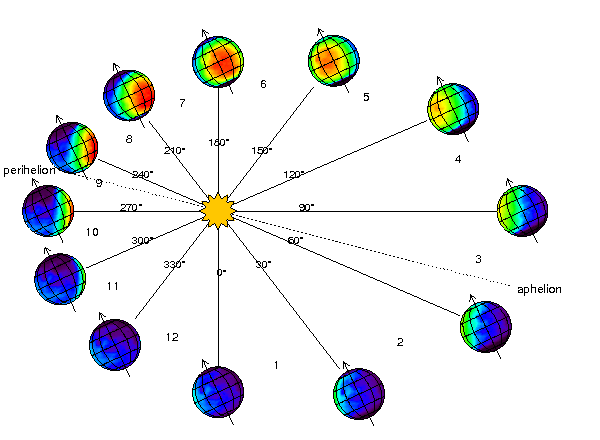
Solar insolation over its orbit – Image credit: http://www-mars.lmd.jussieu.fr/mars/time/solar_longitude.html
Yesterday marked the official start of Summer on the South Pole of Mars and the shortest day of the year in the Martian Southern Hemisphere. The carbon dioxide ice sheet that once covered places like Inca City, Manhattan, and Ithaca should be gone or nearly gone at this point. The dark fans and blotches imaged by HiRISE in August-November of last year (and you can now map those images from Inca City in that sequence on the site) have now disappeared back into the regolith. The days will begin to get shorter and the HiRISE seasonal monitoring campaign will eventually switch to the Northern hemisphere. But the geysers and fans will be back in the South and so will the HiRISE images starting around mid 2016.
In the meantime, we’ve got plenty of images of fans and blotches needing your help to map at http://www.planetfour.org
Brand New Images of Inca City!

For the past while we’ve been focusing on Inca City, and now we have even more images for you to explore. As our way of saying thanks for the hard work and time you put into Planet Four over the past two years, we’ve uploaded the 6 HiRISE images (find out more in here and here) that were publicly released by our friends on the HiRISE team based on your vote back in August.
The cutouts shown on Planet Four are HiRISE images are nearly as close to right off the Mars Reconnaissance Orbiter as we can get. These observations span from this past August,when the sun began to rise about the horizon ( the start of the Season 5 monitoring campaign), to as recent as November of last year.
The images will add to our understanding of the South Pole and its seasonal processes. We have already Season1-3 of Inca City classified thanks to your help. The science team is working now on analyzing those results. We have Season 4 and now 5 of Inca City soon to come with your clicks. These new images will expand the baseline we have on the behavior of the geysers,fans, and blotches to 5 Martian years.
If you have a moment or two to spare, please help by mapping fans and blotches today at http://www.planetfour.org.
Happy New Earth Year
Happy New Earth Year, Earthlings! Thanks for all of your help this year. If you’re a Martian, you’ll have to wait another few months (June 18, 2015 to be exact) to celebrate Mars Year 32 drawing to a close . That’s because Mars takes nearly twice as long ( 687 days) as the Earth to complete one revolution around the Sun. To mark another Earth year of Planet Four, we have gathered together some favorite images suggested on Talk. Enjoy!


Merry Fans of Manhattan
Season’s Greetings. From all of the Planet Four team to all of you on Earth and Mars, we wish you a very merry Earth solstice, Happy Holidays, and a very happy new Earth Year.

Image credit: NASA/JPL/University of Arizona
Another holiday treat released by the HiRISE team this December was a 3-D image or anaglyph of Manhattan taken in November. You can find the full image here.
If you throw your red and blue 3-D glasses on, you should see the troughs of the spiders channels with fans dotting the surface. With these observations planetary scientists can measure depths of the channels and slopes of terrain. These images are created by combining two images of the same location (called a stereo pair) where HiRISE was oriented at different angles to the surface. You can read about the details here.
And if you’re looking for a cocktail for your new year’s party – check out this year’s Zooniverse cocktail list including a Planet Four themed drink (the last door of the Zooniverse’s advent calendar)
Adding Some Red (Planet) to the Holiday Season

Image Credit: NASA/JPL/University of Arizona (http://www.uahirise.org/ESP_038510_0985 )
Adding more red (planet) to this holiday season, another new HiRISE image of Inca City was publicly released by the HiRISE team this month. This is the 6th image from the sequence taken this fall as part of Season 5 of the seasonal monitoring campaign (We’re currently showing images from Season 4 on Planet Four). The image sequence was released as part of the public vote we organized with the help from our friends on the HiRISE team. You can find the rest of the sequence here.
Meet the Team: Darren McRoy
Today we have the next installment of our Meet the Planet Four Team series, featuring Darren McRoy from the Zooniverse team.

Name: Darren McRoy
What is your current position and where/institution?
I am currently the Zooniverse Community Builder at the Adler Planetarium in Chicago, IL.
Where are you originally from/where did you grow up?
I was born in Beverly, MA, and raised in Andover, MA. I moved to IL to attend Northwestern University, starting in 2006.
In 3 lines explain what you do as part of the Zooniverse development team?
My primary role is to be a liaison with our citizen science community as we continue to expand the Zooniverse in exciting new directions. I also assist in general communications efforts, such as producing and editing written content for projects. Currently, I am working closely with our designers and developers on the next generation of Zooniverse’s Talk discussion system.
Why do you find interesting about Mars?
Both the possibility of human habitation and the incredible barriers that exist towards making it a reality.
What is your favorite movie?
Airplane! (1980)
What is your favorite book?
Catch-22 by Joseph Heller (1961)
What is the song you currently can’t get out of your head?
“And Then There Was Silence,” Blind Guardian, A Night at the Opera, 2002
What three albums would you bring with you to a desert island?
Land of the Free, Gamma Ray, 1995
The River, Bruce Springsteen, 1980
Thriller, Michael Jackson, 1982
Favorite cocktail or beverage?
Any witbier/Belgian white beer
One Mars Year of Planet Four
Mars takes 687 day to complete one revolution in its orbit around the Sun, nearly twice as long as on Earth. We launched Planet Four on January 8, 2013 and today marks one full Mars year of Planet Four. Happy 1st Mars year birthday to Planet Four!
To celebrate and to thank you for all your contributions to Planet Four since launch, we’ve made a poster using all of your names*

The full poster can be downloaded here (it’s big – 22 MB download!), and a smaller resolution version (2 MB download) can be found here. You can find the original image used to make the poster here. It’s a subimage made by the HiRISE team from this newly released Inca City Season 5 image. We picked this image because of all the activity shown. Fans and blotches galore! Did you find your name?
Thanks for all your clicks over this Martian year. The science team is working hard on finishing the first paper based on your classifications. We’re almost there, and plan to submit in early 2015. We couldn’t do this without your time and effort.
Help celebrate Planet Four’s first Mars year anniversary by mapping fans and blotches in HiRISE images today at http://www.planetfour.org
*Names are only shown for volunteers who gave permission for us to show their name on the Zooniverse account settings. To update your settings login to https://www.zooniverse.org/account/settings and update the ‘name’ field.
That’s not Mars!

Credit: NASA/JPL/University of Arizona
The image above taken by HiRISE isn’t of the South Pole of Mars or any region on Mars for that matter. It’s an interloper from the Oort cloud (reservoir of the long period comets) coming in for a close encounter to Mars on its way into the inner Solar System for its closet approach to the Sun. This icy planetesimal originated in the Oort cloud and was perturbed onto an orbit that has slowly brought it into the inner Solar System and on a path that brings the comet close to Mars. So close in fact (87,000 miles away from Mars) that this is closer than any comet has come to Earth since the dawn of modern astronomy. This provided a rare opportunity to study this icy remnant of planet formation up close and personal with the flotilla of spacecraft orbiting Mars.
HiRISE, is the highest resolution camera sent to to the Red Planet, and the images you see on Planet Four come from it. HiRISE is designed to taken observations staring below at Mars. It’s a push broom camera so it’s using the motion of the spacecraft (Mars Reconnaissance Orbiter, MRO) its aboard to create the image. To observe a comet requires a whole different way of observing using MRO to point and slew to target the comet. This was no easy feat but the HiRISE team accomplished it, taking images of the comet several days before and shortly before cloest encounter. During the closest part MRO was behind Mars to shield it and its instruments (including HiRISE) from the large amounts of dust entering the Martian atmosphere and could possibly damage or destroy the onboard instruments. This is likely the best optical image of Comet C/2013 A1 Siding Spring, we’ll have. It may look blurry and span only a few pixels, but observations like this will significantly constrain the size of the nucleus. Congratulations to everyone involved for making these challenging observations successful.
This is the only the second comet imaged by HiRISE. HiRISE has tried this previously observing Comet ISON, a sun-grazing comet that broke up shortly before or during its encounter with the Sun. HiRISE imaged ISON’s nucleus and was able to put the best size constraints on the comet (better than the limits from the Hubble Space Telescope), that placed it around 1 km or smaller. With that size, ISON would be predicted not to survive matching the observations. The cool thing about both Siding Spring and ISON is that these comets were discovered with at least a year’s notice before their closest approach giving astronomers and planetary scientists time to apply for telescope time and mobilize resources (including spacecraft orbiting Mars!) to observe these elusive objects.
You can read more about these HiRISE observations here and here. If you’re interested in hearing more about observations like this get undertaken by HiRISE and the team behind the camera check out this Planet Four Live Chat where we had discussing the preparations for the Comet ISON imaging with Kristin Block and Christian Schaller. For a summary of all the Comet Siding Spring observations taken by the spacecraft orbiting Mars check out this blog by the Planetary Society’s Emily Lakdawalla.
 Planet Four Blog