Planet Four Now Available in Simplified Character Chinese
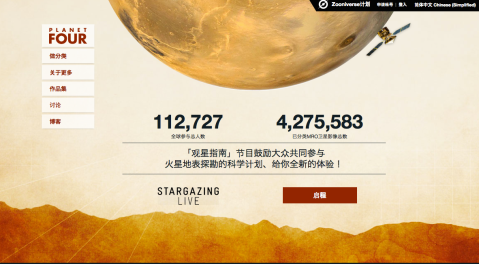
欢 迎光临第四行 星!We’re pleased to announce that Planet Four is now available in simplified character Chinese. Thanks to the efforts of the Education and Public Outreach (EPO) Office and Zheng Meyer-Zhao at the Institute of Astronomy & Astrophysics, Academia Sinica (ASIAA) in Taiwan. Also a big thank you to Chris Snyder from the Zooniverse’s development team at Adler Planetarium for all the technical help and to Ning Ding at the Lunar and Planetary Laboratory at the University of Arizona for help verifying the translation. Below is a note from Zheng Meyer-Zhao and some info about the site both in simplified Character Chinese and in English:
Zheng Meyer-Zhao
I am a software engineer at ASIAA, born and raised in the north-east of China. It has been my pleasure to participate in the translating efforts the Planet Four website to simplified Chinese. During the Citizen Science workshop organized by Meg in March 2014 at ASIAA, I learned that many people worldwide are joining this great project in their spare time to help out scientists. However, there are not many people participating from China yet. The main reason of this is the availability of the information, as there was no Simplified Chinese site available. The simplified Chinese version of Planet Four provides a perfect opportunity for people in China to join the exciting cutting-edge project to enjoy and experience the amazing images of Mars.
赵征
我是中研院天文所的软件工程师,生长于中国东北。我很荣幸能帮助第四行星翻译简体中文网站。2014年三月,Meg 在 中研院天文所组织公众科学研讨会。从一个星期的研讨会中,我了解到, 来自世界各地的志愿者朋友们利用他们的闲暇时间参与宇宙动物园的项目,来帮助科学家们分类海量图像,可是却还没有很多国内的志愿者朋友参与。这其中主要的 原因是缺乏相关讯息,因为宇宙动物园的项目还没有简体中文网站。前一段时间Meg请我帮忙翻译第四行星的网站,我欣然答应。希望第四行星的网站可以给国内的志愿者朋友们提供一个了解火星的平台,让更多的人能够参与这个令人兴奋的项目,体验前所未有的精彩火星图像。
欢迎光临第四行星!
欢迎光临「第四行星」。行星科学家正在计算测量火星地表特征,很 需要你的辨识和协助。在此和你面对面的火星地表图像非常独特,绝对都不会在地球上出现,因为每张图像都取自火星的南极!对火星南极这块陌生区域,我们的了 解仍极有限,其中大部分是人类未曾亲眼见到过的火星景象!
请问我要帮忙找啥?
我们需要你帮忙找出火星地表上的「扇形」和「暗斑状」的图(以下简称「扇形」、「暗斑」),并且用框线的方式做出标识。科学家认为这些形状特征代表 风向和风速。只要持续追踪「扇形」和「暗斑」,经过几个火星年后,我们将会渐渐知道这些特征是如何形成、发展以及它们会怎样消失和变化,这能帮助行星科学 家深入了解火星气候。此外,如果相同特性总在相同地点形成,也将有机会认识到这些地表特征会怎样在经年累月后发生变化。
为什么需要这么多人帮忙?
卫星采集回来的火星照片数量庞大,这些需要分类的工作若光靠少数科学家自己做,做不完!而电脑对图像辨识标记这件事,几乎帮不上忙。老实说,人脑能处理的复杂性分析,当然远超过辨识这些火星图像!不是吗?
想知道关于你标识的每幅图像的结果我们会如何处理吗?我们会把所有志愿者的标识结果都放在一起。经过加总平均运算机制,产生一个完整可靠的火星地表「扇形」和「暗斑」总地图,首度完成火星大规模风向风速测量计划!
Welcome to Planet Four!
Welcome to Planet Four, a citizen science project designed to help planetary scientists identify and measure features on the surface of Mars . . . the likes of which don’t exist on Earth. All of the images on this site depict the southern polar region, an area of Mars that we know little about, and the majority of which have never been seen by human eyes before!
What am I looking for?
We need your help to find and mark ‘fans’ and ‘blotches’ on the Martian surface. Scientists believe that these features indicate wind direction and speed. By tracking ‘fans’ and ‘blotches’ over the course of several Martian years to see how they form, evolve, disappear and reform, we can help planetary scientists better understand Mars’ climate. We also hope to find out if these features form in the same spot each year and also learn how they change.
Why do you need our help?
There are far too many images for a group of scientists to get through alone and computers are just no good at detecting the features we are trying to mark. The human mind is far superior at analyzing images with the complexity of the Martian surface!
Your markings will be collected together with the markings made by other volunteers on that same image. Taking an average of these markings, we will produce an extremely reliable map of the ‘fan,’ and ‘blotch’ features on the surface of Mars and the first large scale measurement of wind on the planet.
Look Up
Time to take a break from the computer screen and take a look at the night sky. This month, that bright red star near the moon, isn’t actually a star it’s our sister planet Mars. Mars was at opposition (where you have Mars, Earth and Sun in a straight line with Mars 180 degrees on the other side of the Sun with the Earth in the middle ) earlier on in April. If we were dealing with circular orbits, then opposition would also be the point of closest distance between the Earth and Mars, but it’s not. Mars was at opposition on April 8th and it was closest to the Earth on April 14th. This celestial alignment happens every ~26 months (reason why missions to Mars launch roughly every 2 years to take advantage of the small distance between the two planets). You can find a nice description of Mars’ opposition and how it works here and here.
Even though its’ past the 14th, Mars is still bright in the night sky. With a telescope or a pair of binoculars you can likely make out some details on the surface including the very diminished Northern Polar Ice Cap. The North of Mars is currently in full swing of summer. You may recall that Northern Summer Solstice (Southern Winter Solstice occurred back in February),so the northern cap has been thawing while the carbon dioxide ice cap on the South Pole has been growing. With the eventual arrival of daylight, seasonal fans and carbon dioxide geysers will popping up again on the South Pole soon enough.
If you need help spotting Mars in the evening sky, this sky guide below by the Dark Sky Hire should help. Even by eye, Mars will have a reddish hue compared to other neighboring stars in the sky.
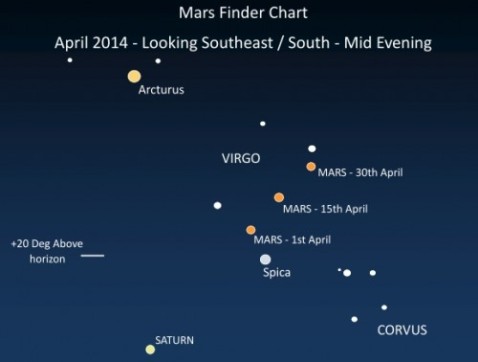
Image credit: Dark Sky Telescope Hire http://www.darkskytelescopehire.co.uk/see-mars-at-its-best-in-march-and-april-2014/
So in between mapping some fans and blotches tonight, take a break from classifying, look up, and catch a glimpse of the planet your clicks are helping us to better understand!
Planet Four Teacher Workshop Talk
As part of the workshop on Citizen Science in Astronomy that I helped co-organize at my research institute (the Institute of Astronomy & Astrophysics, Academia Sinica – ASIAA) earlier this month in Taipei, Taiwan, there was a teacher workshop. The teacher workshop was organized by Lauren Huang (ASIAA), Mei-Yin Chou (ASIAA), Stuart Lynn (Adler Planetarium/Zooniverse), Kelly Borden (Adler Planetarium/Zooniverse), and myself.
Teachers in Taiwan came to ASIAA on a Sunday to hear about citizen science and how they could use it in the classroom. I gave a talk to introduce the traditional character Chinese translation of Planet Four and talk about the science behind Planet Four. The talk (which is in English) is recorded so I thought I’d share:
Boulders in Inca City
Thanks to your help, we’ve been able to complete the set of Season 1 Manhattan images with 30 independent reviews. We’re now moving on to Inca City Season 1 images. You might notice bright light-colored small smooth circles and ovals in the images showing in the classification interface. Those features are actually boulders. HiRISE can resolve down to the size of a small coffee table on Mars, so those boulders aren’t so tiny!
It has been suggested from previous analysis that boulders may impact the prevalence of fans and blotches in Inca City. If you come across an image that has boulders, please discuss the image on Talk (hit the ‘Discuss’ button – it appears after you click the ‘Finish’ button once you’ve marked the fans and blotches in the images) and add the hashtag #boulders. This will mark the image as possibly having boulders, and the science team can look at these later to see if we can try and find any possible correlation with fan and blotch activity and morphology.
Below are some examples of images with boulders for reference. Click any of the images for a larger view and slide show:


Opportunity for a Summer Student to Work on Planet Four Data
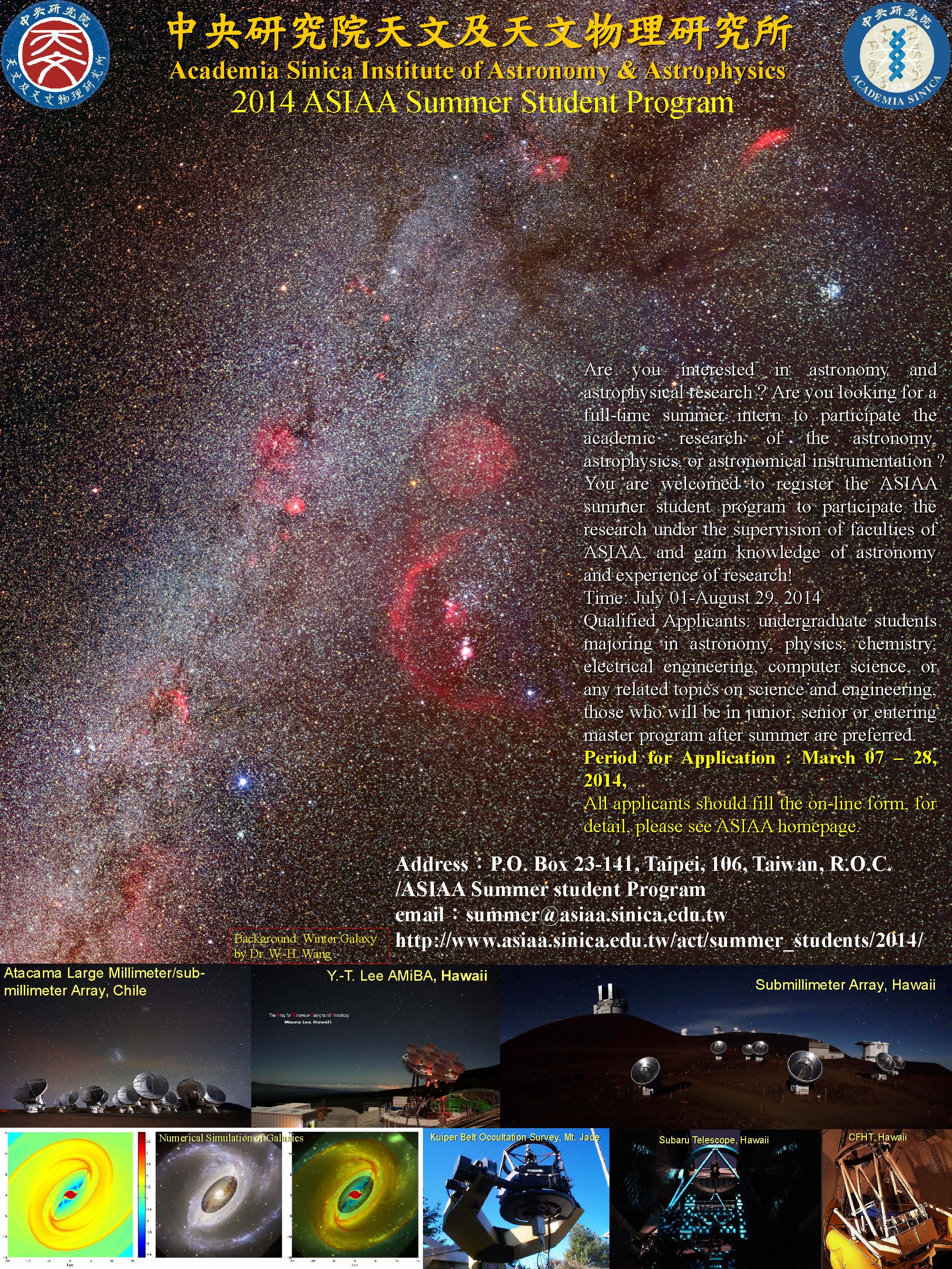
I’m a postdoctoral fellow at the Institute of Astronomy & Astrophysics at Academia Sinica (ASIAA) in a Taipei, Taiwan. As part of the 2014 ASIAA Summer Student Program, we’re looking for an undergraduate student to come to Taipei for the summer, from July 1st-August 29th, to work on Planet Four related research. ASIAA operates in English, and all research will be conducted in English. The description of the project can be found here. Details about the Summer Student Program including rules and restrictions can be found here.
Applications are due before March 28th. If you have questions or if you would like to know more, you can contact me via email at mschwamb AT asiaa.sinica.edu.tw
Planet Four Now Available In Traditional Character Chinese

歡迎光臨第四行星!We’re pleased to announce that Planet Four has been translated to traditional character Chinese thanks to the Education and Public Outreach (EPO) office at Academia Sinica’s Institute of Astronomy & Astrophysics (ASIAA). A big thank you to Lauren Huang for translating and Mei-Yin Chou for verifying the translation. I’m a postdoctoral fellow at ASIAA and Lauren, Mei-Yin, and I will be introducing Planet Four and the new translation to educators from around Taiwan at a teacher workshop on March 2nd as part of a larger workshop on Citizen Science in Astronomy hosted at ASIAA from March 3-7th. Michael and I will both be attending the full workshop as well.
Also many thanks to the Zooniverse’s Chris Snyder for getting all the technical things set up for the translation to go live on the site in time for the teacher workshop, and thank you to the Zooniverse’s Rob Simpson and Michael Parish for their help as well.
Are you interested in helping translate Planet Four into other languages? Find out more here.
What follows is the announcement from ASIAA, in English and then in traditional characte Chinese regarding the new Planet Four translation.
No rocketship required, help scientists study Mars from Earth
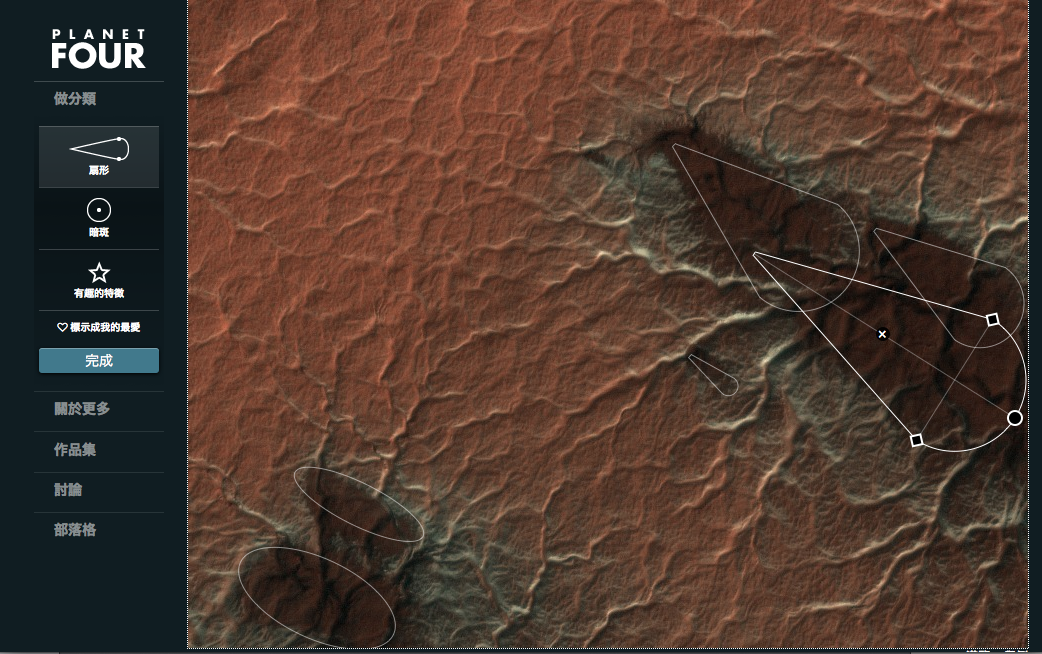
We need your help to explore Mars. On Planet Four (http://www.planetfour.org/?lang=zh_tw), you will be shown images of the South Pole of Mars taken by the HiRISE camera aboard the Mars Reconnaissance Orbiter. We are asking you to mark dark fans and dark blotches that appear and disappear during the Spring and Summer on the South Pole of Mars. During the winter carbon dioxide (CO2) condenses from the atmosphere onto the ground and forms the seasonal ice sheet. The ice begins to sublimate in the spring, and the seasonal cap retreats. The dark fans and blotches begin to appear in the Southern spring when the ice cap begins to thaw and sublimate back into the atmosphere. The fans and blotches then disappear at the end of the summer when there is no more ice left.
We want to study how these fans form, how they repeat from Spring to Spring and also what they tell us about the surface winds on the South Pole. If the fans are places where the wind is blowing, then they tell us the direction and the strength of the wind. Blotches then tell us where there is no wind. This is a task that computers cannot do, but which humans are really good at. We need to collect together many people’s markings and combine the results to be able identify the fans and blotches in the HiRISE. With your help mapping the seasonal fans and blotches, we can better study and understand the Martian climate. Explore Mars today at http://www.planetfour.org/?lang=zh_tw!
(Below is Lauren, the translator, wrote to share her excitement: )
As planetary scientists delight in seeing their probes launched into space, now that the Chinese translation of the Planet Four website is finished, we are also excited for more new volunteers from our own country are about to join this project! Either by way of a probe or a newly added translated language, the two things is similar: opening up a gate to a new world always makes us feel great!
Meg asked me to say a few things as to “why I translate the website for Planet Four”. Of course, the number one motive is serving the community! During the translating process, I constantly thought about the participants of zooniverse, that they are voluntarily doing this, offering their time and resource to support science research; it is our duty to put things in clear Chinese with correct science, so that our helpers can enjoy their science quests with pleasure. However, this task is not easy and is impossible if without my colleague’s help! I’d like to thank Dr. Mei-Yin Chou greatly, who helped verifying each paragraph throughout the site.
Chinese proverb says “one step back, a broaden sky” (退一步海闊天空). I guess whenever people have the time to log in this Planet Four website, it could be a time set aside as a retreat designated of Mars exploration. We are all curious to know more about the fourth planet of our solar system and can’t wait to see how the wind blows there! Have fun!
Help planetary scientists study the climate of Mars at http://planetfour.org/?lang=zh_tw
科學家找你幫幫忙:研究火星氣候不用火箭,立馬就上!
左鄰拉右舍,樓上牽樓下,探索火星氣候需要大家作伙來幫忙。如果你還沒聽說的話,第四行星網站(http://planetfour.org/?lang=zh_tw)是個需要靠人來幫忙辨識圖像的地方,這個網站會顯示一些火星南極圖像給你──這些照片都是由裝在火星偵察軌道機上的HiRISE照相機從火星南極現場拍回來的。按電腦程式出題,網站會請分類員對黑色暗斑和扇形圖像做出標示。這些圖像春季出現、夏季消失,地點是在火星南極。冬季時,火星大氣中的二氧化碳(CO2)會在地面上結凍,形成季節性冰席(ice sheet)。當春季來臨,火星南極的冰冠開始融化,昇華到大氣,到盛夏所有冰層都融化的時候,這些黑色扇形物跟斑點就全部消失了。
第四行星計畫想研究的是這些扇形如何形成,如何年復一年地循環著春夏秋冬四季,並認識南極地表的風。暗斑代表無風,而如果有風在吹則會形成扇形,我們能依此知道風的方向和強度。這項任務特徵是,電腦做不來,但人類卻能輕鬆做到,所以只要將很多人的標示結果集中結合在一起,就能辨識出HiRISE取回影像中那裡有扇形和暗斑。如此,按季節頻頻出現的扇形和暗斑,在你的協助下,就能協助我們更清楚了解火星氣候。啟程探索火星,不用火箭,今天就可以出發:http://www.planetfour.org?lang=zh_tw
(以下是中文版譯者黃珞文簡單心得分享:)
就像行星科學家因衛星發射而心情歡欣雀躍,我們完成了第四行星中文網站,也因將有一大群新分類員加入本計畫而令人充滿期待;衛星飛越太空,翻譯的人橋接了語言之隔,總之,一個美麗新世界即將亮相!
Meg要我講下翻譯的部分,我們在翻譯過程中最關心的是使用者需求,因為我想到宇宙動物園網站使用者都是自願的義務分類員,在閒暇之餘貢獻自己的資源來協助科學計畫達成目標,所以,能不能讓這群使用者在中文環境下、盡量負擔較小又輕鬆愉快地達成任務呢?感謝周美吟博士的幫忙,在易讀和科學正確這兩項指標上她都幫了大忙!不過如果有哪裡錯誤,還請跟我們說喔!
中國人說「退一步海闊天空」,天是無限想像飛馳的去處,無論平常的身分是什麼,若是有時間登入這個網站時,邀請大家能懷著「即將成為千萬公民科學參與者之一」的寬闊,也帶著些許好奇,一同來鑑識看看這太陽系的第四顆行星上,風會怎麼吹!祝旅途愉快!
天文學家請你幫幫忙!了解火星氣候,今天就上:http://www.planetfour.org?lang=zh_tw
All hail the Zooniverse
All hail the Zooniverse! The Zooniverse is the largest collection of online citizen science projects (which includes Planet Four) and as of Friday, the Zooniverse is now 1 million people strong!
Image Credit: Zooniverse
Congratulations to everyone involved on reaching this milestone! In just a single year, Planet Four represents over 40,000 of the 1 million registered Zooniverse volunteers. (This number just represents the logged-in volunteers. Over 100,000 people have participated in Planet Four to date). Check out the global map of the Zoonvierse community (made by Rob Simpson) to see where all the registered volunteers (including Planet Four participants) come from. If you don’t have a Zooniverse account, you can sign up today.
To give some history, the Zooniverse started back in 2007 with the launch of Galaxy Zoo to study galaxy morphology. It turns out that human beings are the best beating computers at determining whether a galaxy is a spiral or an elliptical or if the galaxy hosts a bar at its center or not. 7 years later, Galaxy Zoo is in its 4th iteration and the Zooniverse now hosts over 20 online citizen science projects which have contributed to date in total over 50 scientific publications. You can see how the Zooniverse has evolved over time in this blog post by the Daily Zooniverse. Although the Zooniverse started in astronomy, it now spans a wide range of fields including projects determining if whales have accents and transcribing World War 2 diaries.
Congratulations to everyone involved in the Planet Four community and thank you for the clicks. We couldn’t do the science without your contributions and your time. The Planet Four science team is working hard to use your classifications to understand the seasonal processes on the South Pole of Mars. Stay tuned to the blog for updates on our progress over the coming weeks and months.
Keep your fan and blotch mappings in Manhattan coming at http://www.planetfour.org and don’t forget to check out all the Zooniverse projects at http://www.zooniverse.org
Grab your 3-D glasses
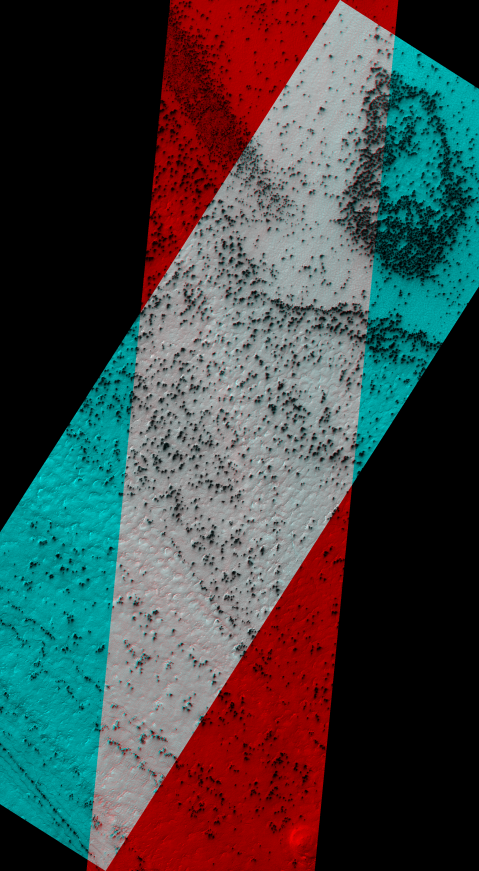
Image Credit: NASA/JPL/University of Arizona
http://www.uahirise.org/anaglyph/singula.php?ID=ESP_011351_0945
For orbiting spacecraft a trick with spacecraft orientation can be used to get 3-D information on the terrain of a planetary body. If images of the same region are taken at different angles, these images (usually taken as two images called stereo pairs) can be combined to make stereo or 3-D images. This is the same technique our brain uses to generate depth perception. This is because our eyes are spaced apart, each eye has a slightly different view of the things in front of us. Our brains automatically combine the information from the two images to gauge the distances to and construct the sizes of objects in our vision.
The HiRISE team does this by commanding the Mars Reconnaissance Orbiter to point such that the HiRISE camera rolls either left or right of the ground track of the spacecraft as its above a target region. This technique has been used to created digital terrain and elevation models of the landing sites for the Mars rovers and other areas of interest on Mars. Anya from the Planet Four team is working on analyzing a stereo pair of the spiders as she mentioned in one of our previous live chats.
A popular way to view a stereo pair from orbiting spacecraft is in what is called a stereo anaglyph where the images are combined such that there is one image for the left eye and one image for the right eye. The left looking image is displayed in red and the right looking image is displayed in blue. If you have a pair of red-blue 3-D glasses, you should see the the above image in 3-D.
I happened to come across an analgyph (the image above) of the seasonal fans taken during the monitoring of the South Pole in Season 2, and I thought I’d share. The full resolution 3-D image can be downloaded from here , and you explore the full-res image with zooming and scrolling capability with the HiView tool. Grab your 3-D glasses and enjoy!
One Earth Year of Planet Four in Images
Planet Four’s 1st birthday is on Wednesday. To celebrate and thank you for all of your help, below are the 50 most popular images classified. We tallied the number of people who favorited each image we’ve shown in the past year, and those in the gallery below in order came up on top. Click below on any of the images to get a larger view and to get a slide show to peruse through the entire collection. If you’re interested in any particular image, you can find all the images in this Talk collection. Help us celebrate by mapping some fans and blotches today at http://www.planetfour.org


Happy Aphelion
Today marks Mars’ passage through aphelion, its furthest point in its orbit from the Sun. At aphelion, Mars is moving slowest in its orbit while at perihelion, Mars is closest to the Sun and moving at its fastest velocity. Mars has a more eccentric or elliptical orbit than Earth, and has the second highest eccentricity out of the 8 planets in our Solar System.
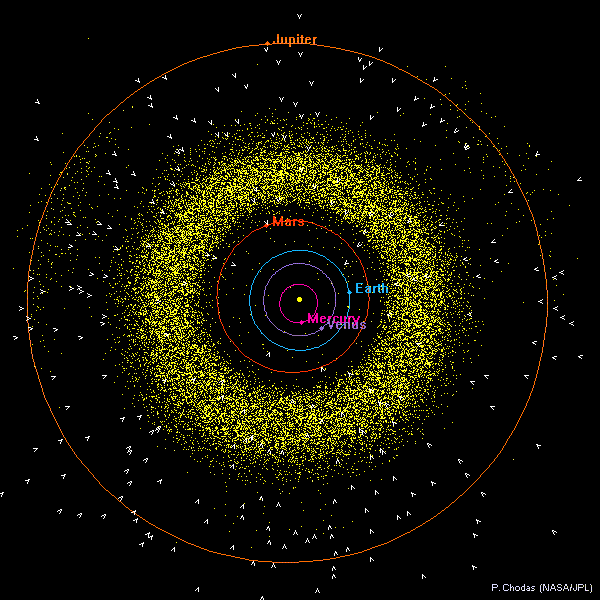
Plot of the inner solar system orbits (yellow dots are asteroid positions). You can see how eccentric Mars’ orbit is compared to the other inner Solar System planets – image Credit: JPL Solar System Dynamics/P. Chodas/ NASA/JPL http://ssd.jpl.nasa.gov/?ss_inner
The Red Planet’s orbital eccentricity may actually be an important factor in Mars’ climate. The Southern hemisphere right now is pointed away from the Sun and the carbon dioxide ice sheet is growing. Compared to the Northern hemisphere, Southern summers are shorter (because Mars is at perihelion during that time) and the solar insolation is more intense while the Southern winters are colder and longer. This dichotomy may be responsible for why seasonal fans and blotches are abundant during the thawing of the carbon dioxide ice sheet in Southern Spring and Summer, but fans and blotches are spotted far and in between in the same seasons in the Northern Hemisphere.
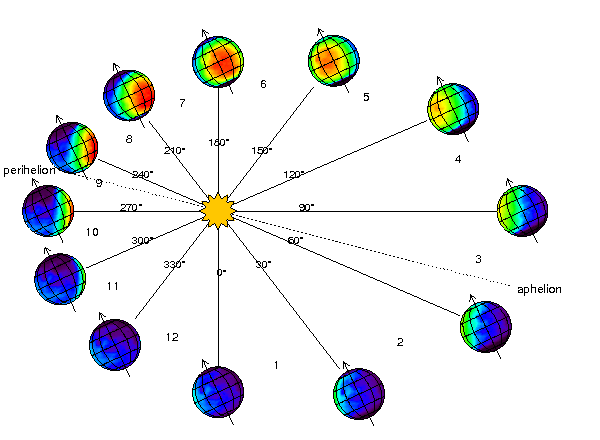
So far seasonal fans and blotches have mainly been spotted on the slopes of dunes at the Martian North Pole and tend to be smaller than their Southern hemisphere counterparts. One of the goals of Planet Four is to better study this. With your measurements of the frequencies, locations, and sizes of fans we’ll eventually compare Northern hemisphere fans to the occurrence and sizes of fans in the Southern hemisphere.
 Planet Four Blog