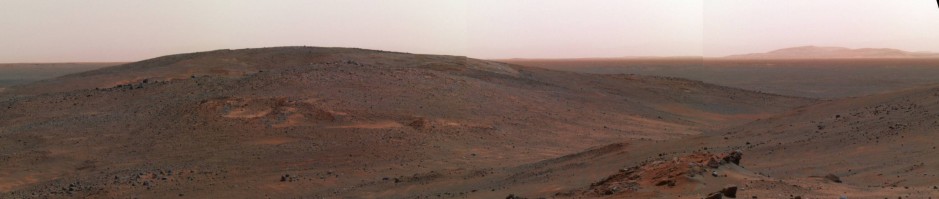
50 Years of the Deep Space Network
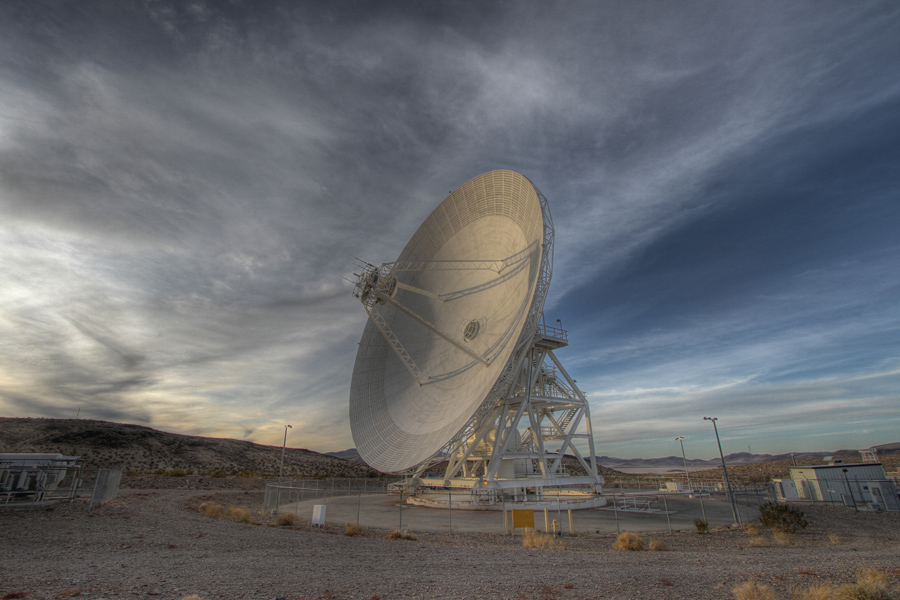
A Deep Space Network Antenna at the Goldstone Deep Space Communications Complex. Image Credit: NASA/JPL-Caltech
Tomorrow marks the 50th anniversary of the Deep Space Network, the array of radio dishes scattered around the globe tasked with communicating with NASA’s space missions orbiting the Earth and beyond. The Deep Space Network is crucial for sending commands to orbiting missions around Mars like the Mars Reconnaissance Orbiter, which is the home of the HiRISE camera that takes the images we show, and receiving the data these robot explorers take of our Solar System and the stars and galaxies beyond it.
Three stations were established so that there would always be at least one of the dish complexes on the Earth rotating into range for communications with a distant spacecraft. Today the Deep Space Network has dishes in Canberra, Australia; Madrid, Spain; and Goldstone, USA. The stations are separated by ~120 degrees of longitude.
In the Deep Space Network’s first year of operations, it communicated with just three spacecraft. In 1969, the Deep Space Station 46 (DSS46) in Australia captured the video sent of Neil Armstrong’s famous first Moon walk from the surface of Moon and relayed the video to the rest of the world. Fast forward 44 years to the present, and the Deep Space Network is now charged with supporting and communicating with over 30 space-based missions from NASA, ESA, JAXA, and ISRO. The Solar System has indeed become a busier and much explored place. The radio antennas are always on and talking with these multitude of robot explorers.
In honor of the tireless work of the Deep Space Network and its operators, let us all map some fans and blotches on the images taken from orbit around Mars that they have help provide us at http://www.planetfour.org.
Happy Birthday Deep Space Network, and whatever planet you are on, wishing you a Happy Holiday Season from all of us at Planet Four to you.
Weather on Mars
We’ve mentioned before in the live chats, and Talk about how the science team would like to test whether the fan directions and the blotch measurements we ask you to make are indicators of the prevailing direction of surface winds on the South Polar regions. We think that the wind is the mostly likely culprit for the sculpting of the fans and that blotches occur when the wind was not strong enough to blow the material into the fans you see in other Planet Four images.
How will we check this? Unlike on Earth, there aren’t weather stations covering most of the globe of Mars taking pressure, temperature, and wind measurements. We’ll have to rely on computer simulations, on the output from a Global Circulation Model/Global Climate Model (GCM) of Mars. A GCM is a computer model of Mars’ atmosphere and climate that simulates all the conditions of the planet’s atmosphere and evolve it over time. PlanetWRF and Ames Mars General Circulation Model are two examples of Mars GCMs.
A GCM attempts to contain in it all the physics and chemistry that planetary scientists know and believe are acting in the planet’s atmosphere. This includes dealing with winds, pressure, atmospheric temperature, chemical reactions, impact of dust and particulate transport in the atmosphere on the whole planet and smaller scales. The simulations also have to take into account how solar insolation varies on the surface of the planet over time accounting for Mars’ orbital parameters changing as well. In addition the climate and weather impact the surface conditions which evolve on the planet over time and feedback into the climate. If you’re interested in reading more about the processes that impact the Martian climate check out the NASA AMES Mars Climate Modeling Group Climate page
Martian GCMs are trying to represent and replicate complicated processes that are happening in the Martian atmosphere. Sometimes things are parametrized to make it possible to program into a computer and may not fully represent the reaction but it is the best scientists can do. The models are continuously improved by comparing to what limited weather and atmospheric measurements we do have of Mars. Mars is the best studied and detailed climate besides Earth in the Solar System. There have been weather stations on the Mars rovers (Curiosity, Spirit, and Opportunity) and landers (including Viking, Pathfinder, Phoenix etc) measuring the wind direction, temperature, pressure etc on the ground. Both Opportunity and Curiosity are continuing to measure the current conditions at their landing sites. Also the fleet of US and European spacecraft (and two new Mars orbiters – one from India and one from the US are currently on their way to Mars) are monitoring the Martian atmosphere providing rich data sets of the upper and middle atmosphere. For example the vertical distribution of dust in the Martian atmosphere and how it changes over the Martian year is obtained from observations from the Mars Climate Sounder aboard the Mars Reconnaissance Orbiter (which also is the home for the HiRISE camera that takes the images you classify).
Once we have the fan pointings and the locations of the blotches over several Martian seasons we’ll use GCMs to predict wind directions and speeds at different times and dates on the ground at the locations the images were taken and see how they compare.
World Space Week
We’ll be starting our live chat shortly. The video link is below. If you have questions for us, tweet us @planet_four.
World Space Week Live Chat

Today marks the start of World Space Week which runs from October 4-10. World Space Week is a yearly event to celebrate and promote the exploration of our solar system and beyond. The week is coordinated by the United Nations with the support of the World Space Week Association (WSWA). The start date (October 4, 1957) honors the anniversary of the launch of the world’s first artificial satellite, Sputnik 1. The end date (October 10, 1967) is to commemorate the Treaty on Principles Governing the Activities of States in the Exploration and Peaceful Uses of Outer Space, including the Moon and Other Celestial Bodies.
This year’s theme is ‘Exploring Mars, Discovering Earth.” Here at Planet Four, with your help, we are exploring an alien process. The carbon dioxide geysers that appear at the Martian South Pole in Southern Spring and Summer have no Earthly counterpart. The prevailing winds blow the material uplifted by these geysers into dark fans and blotches seen from orbit on the ice sheet. For the past 4 Martian years, Mars Reconnaissance Orbiter and the HiRISE camera have been imaging the South Pole to explore the seasonal change. With your help marking the blotches and fans in the HiRISE images, we can tally the numbers of fans and blotches, measure their directions and sizes, and compare how these properties change over time in a single year as well as from year to year. With these measurements, we can better understand the processes that form the geysers and impact the Martian climate itself. By studying Mars’ climate we can better understand the similarities and differences between the sister planets.
To celebrate World Space Week, the Planet Four team is hosting a live chat on Wednesday October 9th 6pm EDT/3pm PDT/11pm BST. We’ll be joined by Planet Four Science Team Members: K.-Michael Aye, Ganna (Anya) Portyankina, and Meg Schwamb . We’ll also be joined by special guests Kristin Block and Christian Schaller. Christian is a HiRISE Ground Data System Software Developer, and Kristin is a targeting specialist for the HiRISE camera. We’ll be discussing more about the Planet Four project, how HiRISE works, and the process from commanding HiRISE to the reduced images that you see on Planet Four.
We hope you’ll join us. We’ll be posting the video live here on the blog. If you have questions for the science team or for our special guests Kristin and Christian, you can post them in the comments or tweet us at @planet_four. In the meantime, why not celebrate World Space Week by exploring Mars at planetfour.org
The Planet 4 Invasion – ZooCon 13 Talk
A few months ago, the Zooniverse hosted ZooCon 13 at the Zooniverse UK HQ in Oxford. I was invited to give a talk virtually about the status of Planet Four and the science behind it. Our own Talk moderator Andy Martin was in attendance and wrote a summary post about the day. My talk is online and you can find it below (the first 30-45 seconds is cut off but the rest of it is all there).
Exploring More With the Images on Planet Four
We’ve added some new features in the past few months, to help make it easier for you to further explore the HiRISE images that you’re classifying on http://www.planetfour.org, and I thought I’d spend a blog post highlighting them. The full HiRISE frames are quite large (typically 2024 pixels in width and 20,000 pixels in height) and to show on the main site we divide them into smaller overlapping cutouts that we ask you to mark fans and blotches in. For each cutout, you can use our discussion Tool (Planet Four Talk), to talk about interesting features you’re seeing, and it is through Talk that can you access the site’s new features.
After you’ve marked the fans and blotches (if any) for the image presented on Planet Four and hit the ‘Finish’ button, you’ll see the ‘Next’ button and below it the ‘Discuss’ button appear. If you hit Discuss, it will take to you to the cutout’s dedicated page on Talk (Here’s an example for cutout APF0000zcd). This is where you can add 140 character comments about the image as well as start longer discussions about questions you have or thoughts and theories with other members of the Planet Four community and the science team.
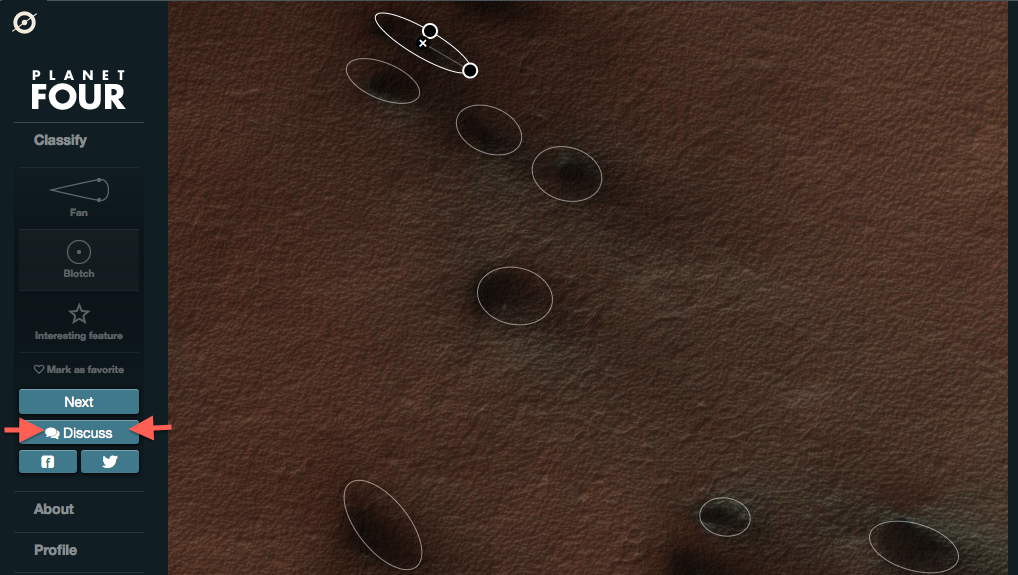
Click on Discuss after hitting the Finnish button in the main interface and it will take you to the Talk page for this cutout
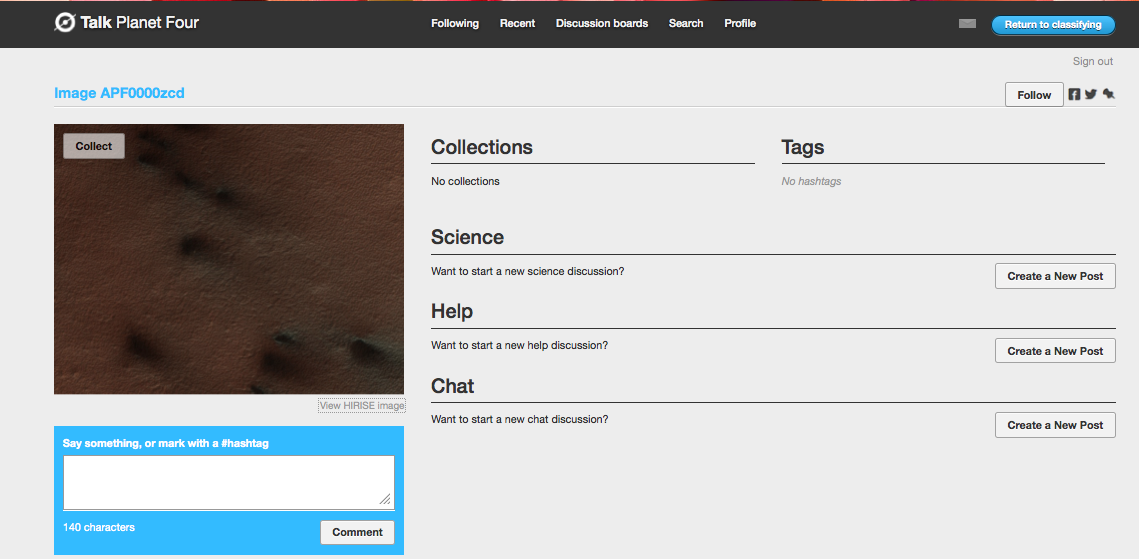
Talk page
While on the Talk specific page for the cutout, if you see a feature you want to examine in more detail, place your mouse over the image. We have added a magnifying glass tool that will appear on the right with a zoomed in version of the image (see below).
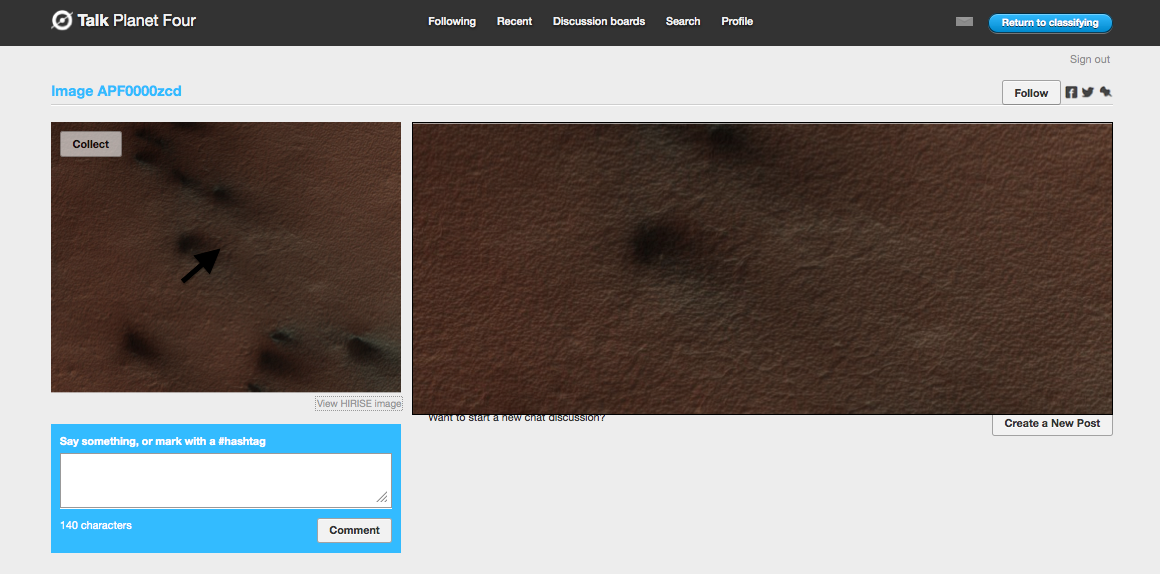
Magnifying glass feature in Talk. Move your mouse over the spot in the image you want to see enlarged
In addition, we’ve added links on Talk to the original HiRISE image (hosted on the HiRISE website) that the cutout you examined is derived from (for an example here’s the page for APF0000zcd). Click on the View HIRISE image link below the image on Talk. From there, you’ll be directed to the HiRISE website, where you can download the full frame observation (we currently use the RGB color non-map projected images) as well as find links to observations taken close to the area over the past 4 Martian monitoring seasons (just scroll to the bottom of the page).
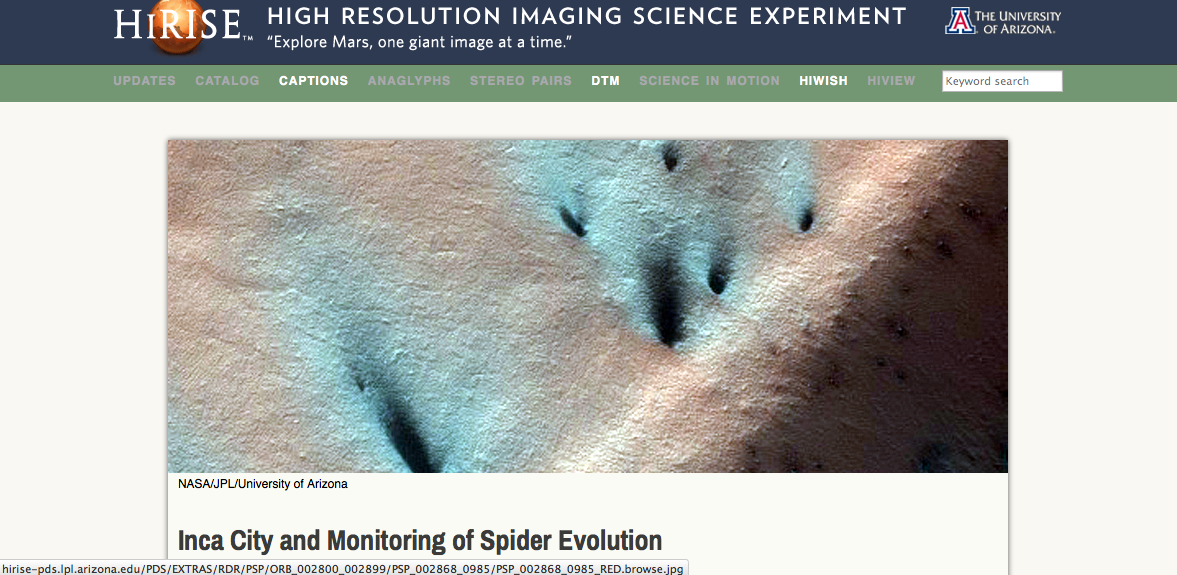
HiRISE website page for full frame image that APF0000zcd is derived from
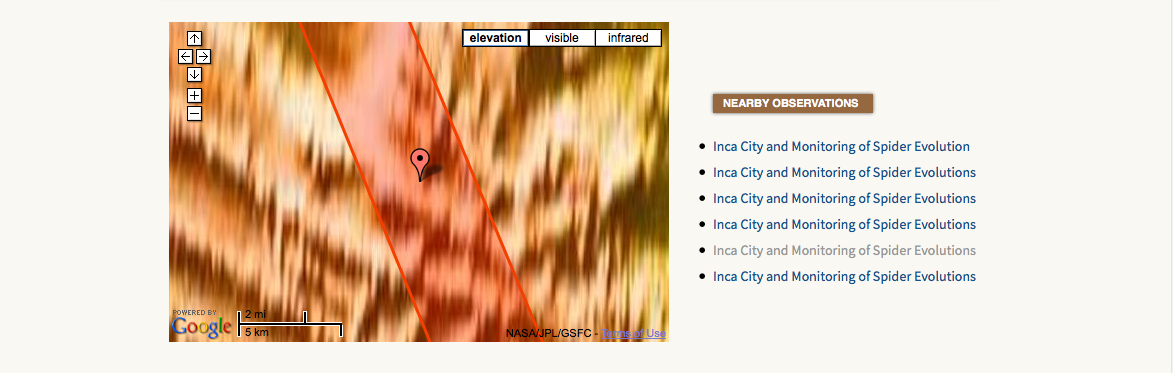
Bottom of HiRISE page with links to nearby observations
Don’t forget you can always explore Talk at any time by going to http://talk.planetfour.org/ and explore the discussions and images that other volunteers have recently classified or commented on.
6 Months of Planet Four

To celebrate Planet Four turning 6 months old and thank you for all of your hard work, we’ve made this poster [21 MB download] (and smaller resolution version 6.5 MB) containing the names* of the more than 72,000 volunteers who have contributed to Planet Four! We hope you enjoy it, and that you are able to find your name in amongst the many that make up this HiRISE image of dark fans and spiders (You can find the original image here). Here’s to the next 6 months!
*Names are only shown for volunteers who gave permission for us to show their name on the Zooniverse account settings. To update your settings login to https://www.zooniverse.org/account and update the ‘name’ field.
New Link for the Live Chat
Some technical difficulties but we are live
Our First Team Live Chat Today
Today we’ll be hosting a live chat with Planet Four science team starting at 7pm BST/6pm GMT/2pm EDT/11am PDT to mark the project’s 6 month anniversary. We’ll be joined by Planet Four PI Candy Hansen (PSI) and science team members K.-Michael Aye (UCLA), Ganna (Anya) Portyankina (University of Bern) and Meg Schwamb (Yale).
We’ll embed the video link here shortly before we start (if you don’t see it try refreshing your browser) and we’ll also tweet the link. You can send us your questions for the Planet Four team during the broadcast by tweeting us @Planet_Four. If you can’t make it to the watch the chat live, the recorded video will also be available here afterwards.
And don’t forget if you have questions after the live chat you can always post them to our Ask a Team Scientist thread on Talk.
Save the Date: Planet Four Live Chat
June marks Planet Four’s 6th month anniversary, and to celebrate we’re having a live chat with the Planet Four science team on June 7th (next week!) at 7pm BST/6pm GMT/2pm EDT/11am PDT .Join us here on the blog to watch the live video feed.
We’ll be joined by Planet Four PI Candy Hansen (PSI) and science team members K.-Michael Aye (UCLA), Ganna (Anya) Portyankina (University of Bern) and Meg Schwamb (Yale). We’ll be talking about the latest Planet Four news and science as well as answering some of your questions. Send us your questions for the Planet Four team, either by leaving a comment here on the blog or by tweeting us @Planet_Four
Update: You can watch the live stream and the recorded video of the chat here.
 Planet Four Blog