One Mars Year of Planet Four
Mars takes 687 day to complete one revolution in its orbit around the Sun, nearly twice as long as on Earth. We launched Planet Four on January 8, 2013 and today marks one full Mars year of Planet Four. Happy 1st Mars year birthday to Planet Four!
To celebrate and to thank you for all your contributions to Planet Four since launch, we’ve made a poster using all of your names*

The full poster can be downloaded here (it’s big – 22 MB download!), and a smaller resolution version (2 MB download) can be found here. You can find the original image used to make the poster here. It’s a subimage made by the HiRISE team from this newly released Inca City Season 5 image. We picked this image because of all the activity shown. Fans and blotches galore! Did you find your name?
Thanks for all your clicks over this Martian year. The science team is working hard on finishing the first paper based on your classifications. We’re almost there, and plan to submit in early 2015. We couldn’t do this without your time and effort.
Help celebrate Planet Four’s first Mars year anniversary by mapping fans and blotches in HiRISE images today at http://www.planetfour.org
*Names are only shown for volunteers who gave permission for us to show their name on the Zooniverse account settings. To update your settings login to https://www.zooniverse.org/account/settings and update the ‘name’ field.
Spring 5 in Inca City
The HiRISE camera right has been taking observations looking for activity on the Martian South Pole over the past few months as part of the new monitoring season (Season 5). In August, we partnered with the HiRISE team for a public vote to determine which polar region would have its first observation prepared for public release. The region dubbed ‘Inca City’ won. We have a big surprise. Not just one image, but all currently available observations this season of Inca City were publicly released by the HiRISE team. That’s right 5 brand new images of Inca City were recently released! You can find these images at:
- Spring in Inca City I
- Spring in Inca City II
- Spring in Inca City III
- Spring in Inca City IV
- Spring in Inca City V
(If you’re looking to make your computer more Planet Four-themed, each of the links above have versions of the images formatted to be computer desktop backgrounds.)
Today, we have a post by Planet Four Principal Investigator Candy Hansen telling tell you more about these observations:
It is southern spring again, and once again we are taking images of our favorite locations. We return to the same sites so that we can study processes from year-to-year. Do spring processes always play out similarly? Or do the occasional dust storms affect when fans appear and the pace of seasonal activities?
This location is known informally as Inca City. As citizens of Planet Four you already know that a seasonal polar cap composed of CO2 ice (dry ice) forms every winter. In the spring the ice sublimates from the top and the bottom of this layer of ice, and under the ice the trapped gas builds up pressure. Eventually a weak spot in the ice ruptures, and the gas escapes, carrying material from the surface with it. The material is deposited on the top surface of the ice, forming the fans and blotches that you have been measuring.

Inca City has distinctive ridges, one of which is shown at the top of this series of cutouts. The first cutout on the left was the first image to be taken after the sun rose, marking the end to polar night. We label time on Mars by “Ls”, which indicates the position of Mars in its orbit. Spring officially starts on Ls = 180, so at Ls = 174 there is very little sunlight. In spite of the small amount of sunlight seasonal activity has already started, and fans can be seen emerging from “spiders”, known formally as “araneiforms”.
These images have not been map-projected yet, so use the black arrow pointing at one of the spiders to orient the same locations from image to image. In the second image from the left, taken about 2 weeks later, you can see that the fan from that spider has become more prominent. In the araneiforms above so much dust has blown out that the individual fans seen in the leftmost image have begun to merge. The ridge is peppered with small spots where the seasonal ice has ruptured (blue arrow). Near the bottom of the second image there are new fans associated with boulders. Below that, at the bottom of the image, four new rupture sites have fans going in multiple directions.
The differences between the second and third images from the left are not substantial. That is because the time difference between the two is just 6 days, or “sols”. Fans on the ridge have lengthened just a bit, possibly due to fine material sliding downslope. In the fourth image from the left, taken at Ls = 191, the fans covering the araneiforms and on the ridge slope appear grey – are fine particles sinking into the ice? At the bottom of the image distinctive bright bluish fans are apparent.
Look at the boxed area in the 5th image and compare it to that same area in the 4th image, just below the indicated spider. The bland surface in the 4th image is now cracked. Polygonal cracks typically occur at this time in the spring. There are no easily-ruptured weak spots, so the pressure of the gas below the ice simply cracks the large plate of ice. The ice must have thinned to the point at which this pressure can break the ice sheet. Once it has cracked the gas escapes and new fans emerge, aligned along the cracks.
The ice has continued to thin by the time of the 6th image, and the araneiforms have likely defrosted entirely. More small fans emerge from cracks in the ice.
That’s not Mars!

Credit: NASA/JPL/University of Arizona
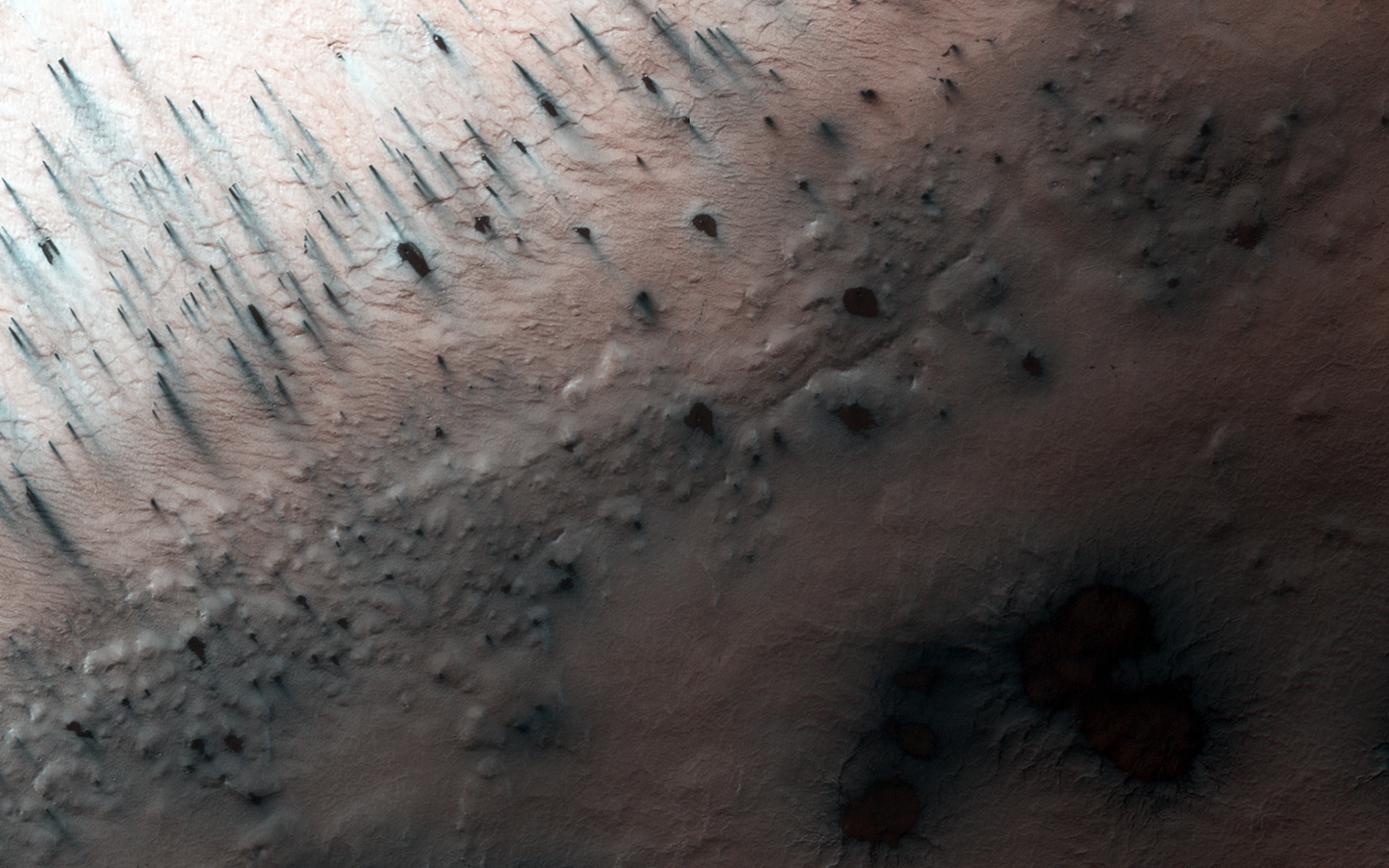
The image above taken by HiRISE isn’t of the South Pole of Mars or any region on Mars for that matter. It’s an interloper from the Oort cloud (reservoir of the long period comets) coming in for a close encounter to Mars on its way into the inner Solar System for its closet approach to the Sun. This icy planetesimal originated in the Oort cloud and was perturbed onto an orbit that has slowly brought it into the inner Solar System and on a path that brings the comet close to Mars. So close in fact (87,000 miles away from Mars) that this is closer than any comet has come to Earth since the dawn of modern astronomy. This provided a rare opportunity to study this icy remnant of planet formation up close and personal with the flotilla of spacecraft orbiting Mars.
HiRISE, is the highest resolution camera sent to to the Red Planet, and the images you see on Planet Four come from it. HiRISE is designed to taken observations staring below at Mars. It’s a push broom camera so it’s using the motion of the spacecraft (Mars Reconnaissance Orbiter, MRO) its aboard to create the image. To observe a comet requires a whole different way of observing using MRO to point and slew to target the comet. This was no easy feat but the HiRISE team accomplished it, taking images of the comet several days before and shortly before cloest encounter. During the closest part MRO was behind Mars to shield it and its instruments (including HiRISE) from the large amounts of dust entering the Martian atmosphere and could possibly damage or destroy the onboard instruments. This is likely the best optical image of Comet C/2013 A1 Siding Spring, we’ll have. It may look blurry and span only a few pixels, but observations like this will significantly constrain the size of the nucleus. Congratulations to everyone involved for making these challenging observations successful.
This is the only the second comet imaged by HiRISE. HiRISE has tried this previously observing Comet ISON, a sun-grazing comet that broke up shortly before or during its encounter with the Sun. HiRISE imaged ISON’s nucleus and was able to put the best size constraints on the comet (better than the limits from the Hubble Space Telescope), that placed it around 1 km or smaller. With that size, ISON would be predicted not to survive matching the observations. The cool thing about both Siding Spring and ISON is that these comets were discovered with at least a year’s notice before their closest approach giving astronomers and planetary scientists time to apply for telescope time and mobilize resources (including spacecraft orbiting Mars!) to observe these elusive objects.
You can read more about these HiRISE observations here and here. If you’re interested in hearing more about observations like this get undertaken by HiRISE and the team behind the camera check out this Planet Four Live Chat where we had discussing the preparations for the Comet ISON imaging with Kristin Block and Christian Schaller. For a summary of all the Comet Siding Spring observations taken by the spacecraft orbiting Mars check out this blog by the Planetary Society’s Emily Lakdawalla.
Meet the Team: Andy Martin
Today we have the next installment of our Meet the Planet Four Team series, featuring Andy Martin one of our Planet Four Talk moderators.

Name: Andy Martin
Where are you originally from/where did you grow up?
Horndean in Hampshire, now own and run a campsite in Bude, Cornwall
What drew you to participate in Planet Four?
Being able to get up close and personal with the surface of another world
What is your role as a Planet Four Talk moderator?
I guess it’s to help people find their way around at Planet 4, answer the questions they have, which I only know the answers to because I asked the same thing when I started out. Hopefully we can encourage them to get involved and not be afraid to post, ask questions and put up their own theories about how things work. And of course I’ve got plenty of questions of my own to post 😉
What do you find interesting about Mars?
What i really like about the Planet4 project is that we are looking at what is still pretty much an unexplored world. There’s lots to look and wonder at, more questions than answers and no-one yet has the definitive line on everything going on with regard to the seasonal fans.
What is your favorite movie?
Animal House
What is your favorite book?
Lord of The Rings is the one I read again and again,
What is the song you currently can’t get out of your head?
The Dahlmanns cover of Amy Rigby’s “Dancing with Joey Ramone”, but I also have a repeat of 2 lines from James – Sit Down running through my head “If I hadn’t seen such riches, I could live with being poor”
What three albums would you take with you to a desert island?
Ohh toughie – Live albums any one from The Ramones – It’s alive/Green Day – Bullet in a Bible/Thin Lizzy – Live and Dangerous ; Wreckless Eric – Greatest Stiffs; Eddie and the Hot Rods – Teenage Depression
Favorite cocktail or beverage?
Youngs Double Chocolate Stout
Meet the Team: John Keegan
Today we have the next installment of our Meet the Planet Four Team series, featuring John Keegan one of our Planet Four Talk moderators.

Name: John Keegan
Where are you originally from/where did you grow up?
I was born in Rochdale, Lancashire. For the last 30 years I’ve lived in the hills of Todmorden, West Yorkshire.
What drew you to participate in Planet Four?
The opportunity to help produce ‘weather maps’ on Mars was too good to miss, but if I’m really honest then I’ve got to admit I was lured by the fabulous HiRISE images on display.
What is your role as Planet Four Talk moderator?
I see myself as something of a ‘tour guide’, answering questions and sharing what I have learnt here on Planet Four. I try to keep track of who’s discussing what, so that I can point visitors to discussions that may be of interest to them. I’ve also got a bit of a reputation as the P4 comedian, but judging by the groans of other visitors I’m not sure that’s working out too well.
What do you find interesting about Mars?
Just about everything I see on Mars is interesting in some way or another, but the ‘spiders’ are definately my favourite objects. I’m beginning to take a particular interest in spiders that form at the bottom of craters.
What is your favorite movie?
It’s a tie between Orwell’s ‘1984’ and ‘Copying Beethoven’ starring Ed Harris.
What is your favorite book?
Another tie, between Orwell’s ‘1984’ and Kepler’s ‘Harmonices Mundi’.
What is the song you currently can’t get out of your head?
‘You Really Got Me’ by the Kinks.
What three albums would you bring with you to a desert island?
All nine symphonies of Beethoven should fit on three albums.
Favorite cocktail or beverage?
Coffee with milk, no sugar, in a never ending stream.
Help Feature Planet Four on the Daily Zooniverse
Have you found an intriguing image you’ve classified on Planet Four? Have you come across a stunning fan field or an image with blue frost? Now’s your chance to have it featured on the Daily Zooniverse. The Daily Zooniverse blog brings something new and different each and every day from across all the Zooniverse, and Grant and the Daily Zoonvierse team are looking for contributions from volunteers (including Planet Four’s Mars Explorers) to present. Just add the hashtag #dailyzoo to an image’s Planet Four Talk page to nominate it. You can learn more here.
Meet the Team: Michael Aye
Today we have the next installment of our Meet the Planet Four Team series, featuring Michael Aye from the Science Team.

Name: K.-Michael Aye
What is your current position and where/institution?
Postdoctoral Researcher at UCLA in Los Angeles, CA, Department of Earth, Planetary and Space Sciences
Where are you originally from/where did you grow up?
I am from Germany, where I grew up approx 100 km northwest of Hamburg, near the North Sea.
What are your research interests/what do you work on?
- Surface atmosphere interactions on Mars, creating visual phenomena that do not exist on Earth
- Calibration of the Diviner radiometer instrument on-board the Lunar Reconnaissance Orbiter (LRO)
- Automated image feature extraction using machine learning procedures
In 3 lines explain your PhD thesis?
I developed a calibration system for the photo-multiplier based cameras of the ground-based high energy gamma-ray telescope system H.E.S.S. This system was based on using nano-second short UV-laser pulses fluorescing a scintillator material and transporting that broader-band light through 50 m of fiber cables and have all this remote controllable. I finished up with installing and operating a LIDAR and radiometer to monitor the atmosphere status as required to cross-calibrate the observed gamma-ray flashes from the particle showers in the atmosphere.
Why are you interested in Mars?
Mars and Venus are the closest siblings of Earth and to understand their differences makes us understand Earth better (but I don’t like the multitude of Venusian chemistry that much.. yet 😉 The lack of water on Mars really makes it a great lab for studying the interface between the surface and atmosphere because on Earth most of what we see is dominated by water-based erosion. On Mars, it’s the wind and amazing CO2 sublimation effects.
What is your favorite movie?
The Matrix
What is your favorite book?
I don’t have much time for reading anymore, but when I did, these books were big fun:
- “Surely you’re joking, Mr. Feynman” (showing a bit too much hubris at times, but he was indeed a genius)
- “Titan” from Steven Baxter (greatly informed S-F)
- The robot novels of Isaac Asimov made me appreciate the complexity of connecting human language and interaction schemes to the operation of machines. It inevitably makes you think about the human consciousness definition as well. A must read for any S-F fan.
What is the song you currently can’t get out of your head?
“Get lucky” by Daft Punk
What three albums would you bring with you to a desert island?
- “Love is the tender trap” by Stacey Kent. The most ingenious introduction to Jazz ever made. Soft, gentle, but with everything that ever was important for Jazz to make it less fringy but more popular. It was my intro to Jazz and I will never stop loving it. It has an absolute genius of a piano player as well.
- “Gran Riserva” by dZihan & Kamien. Great electronic lounge for the long work nights. I basically wrote my PhD with it.
- And now the surprise 🙂 “Once more with feeling”, soundtrack to the musical episode of Buffy the Vampire slayer. Also a remnant of my PhD times, it shows the early genius of Joss Whedon to its fullest.
Favorite cocktail or beverage?
I wouldn’t be able to pick really favorites, but among them are Margaritas on hot days, Caipirinhas and Mojitos. And since my 4 year stay in good ol’ England, I really am loving ales of all kind.
A Summary of a P4 Summer

At the end of August, Chuhong Mai presented a summary and results from her undergrad summer research internship at the Institute of Astronomy Astrophysics, Academia Sinica working with Meg on Planet Four. You can learn more about Chuhong here.
Chuhong spent July and August in Taiwan working on map projecting HiRISE images and exploring frost features. She kindly agreed to share her final presentation talk slides (see below) and some text to describe each slide. Thanks Chuhong for all your help this Summer!
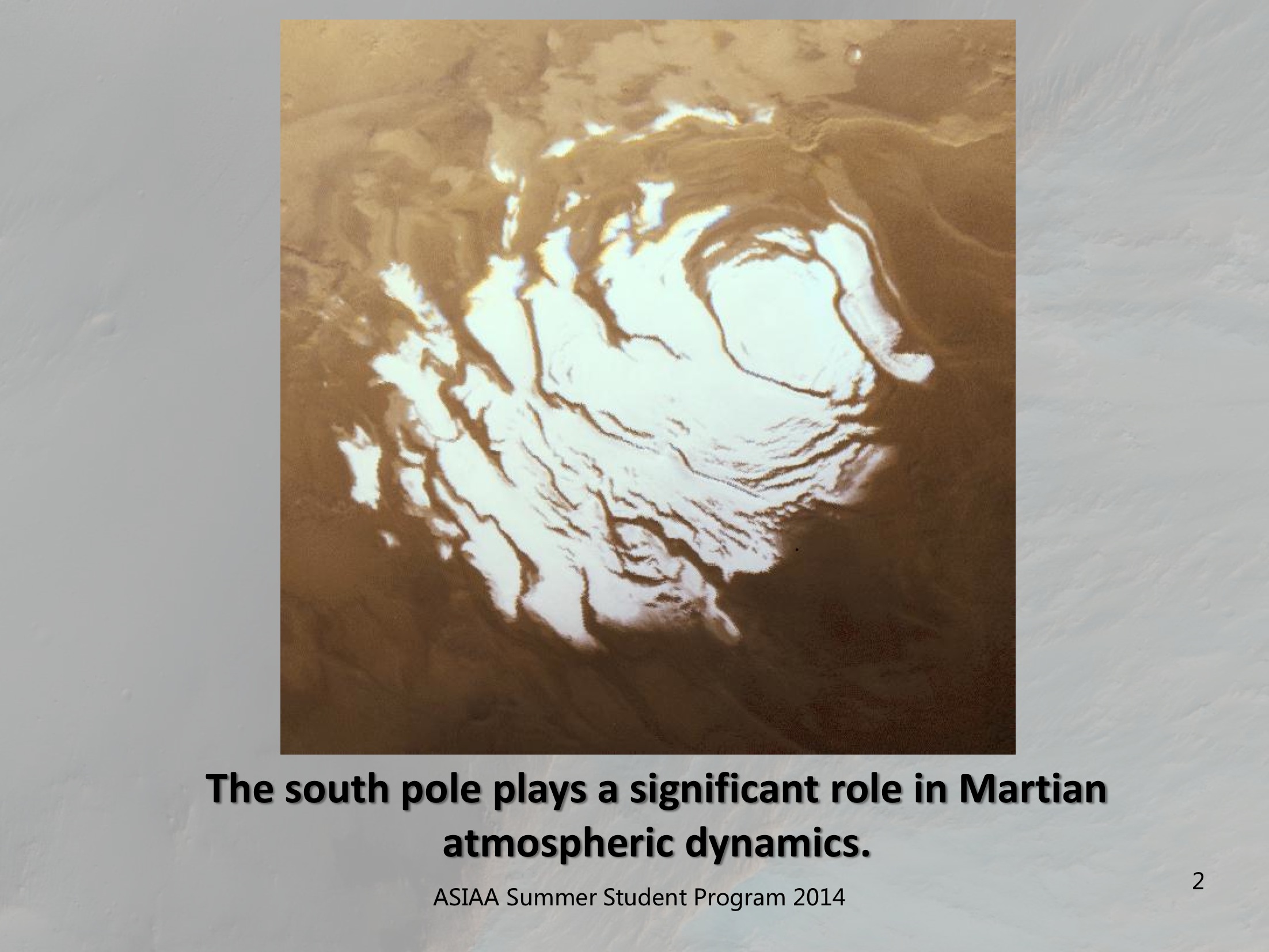 Mars has a very thin atmosphere, 96% of which is . Every year, the two poles of Mars participate in the gas exchange of atmosphere. Since the south pole contains a lot of , it plays an significant role in Martian atmospheric dynamics.
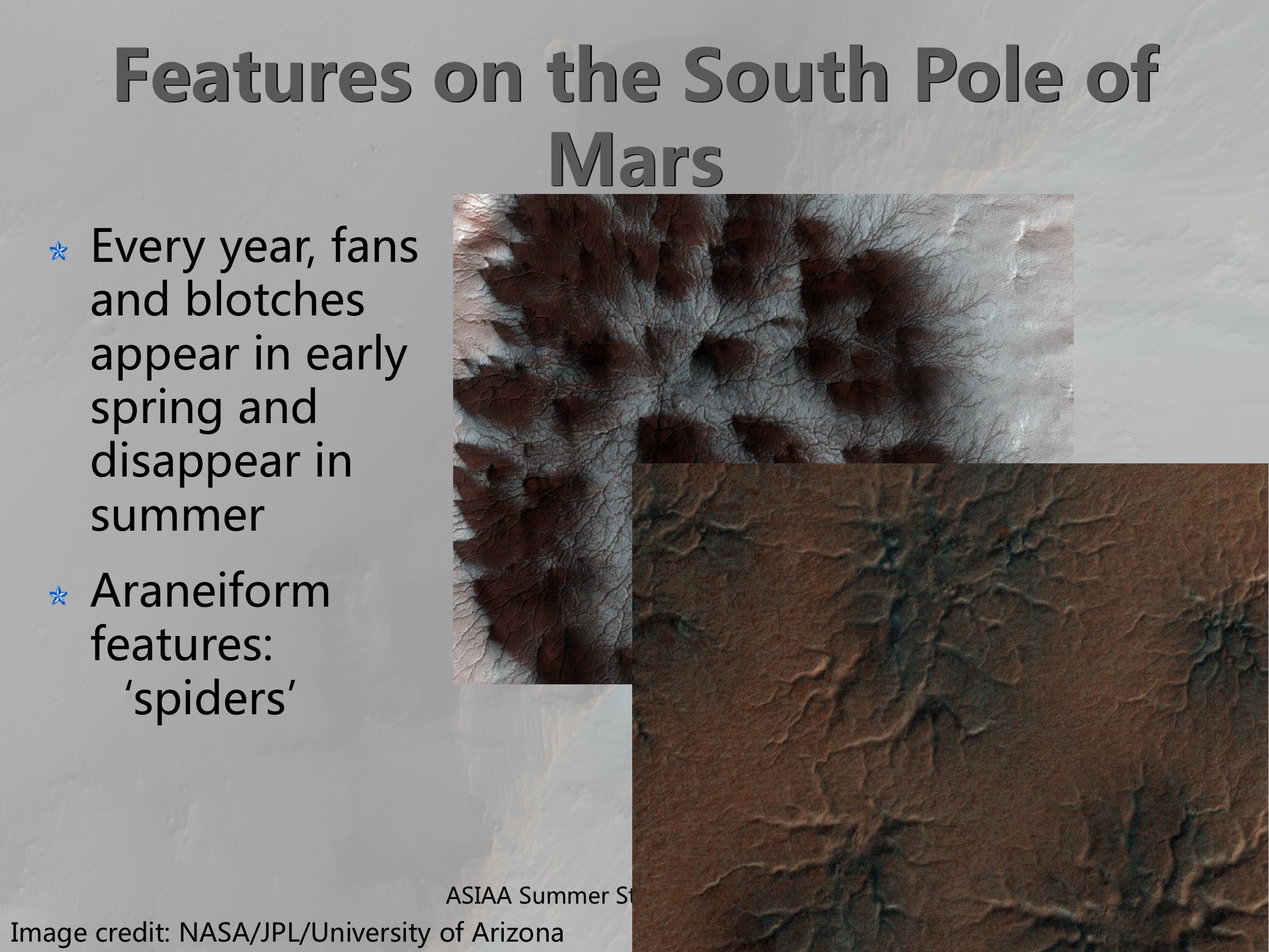 But what’s really interesting is we observe fans and blotches appear in early spring and disappear in summer each year on the south pole. Araneiform features or ‘spiders’, which are radial channels that converge in the center, often accompany those dark stuff.
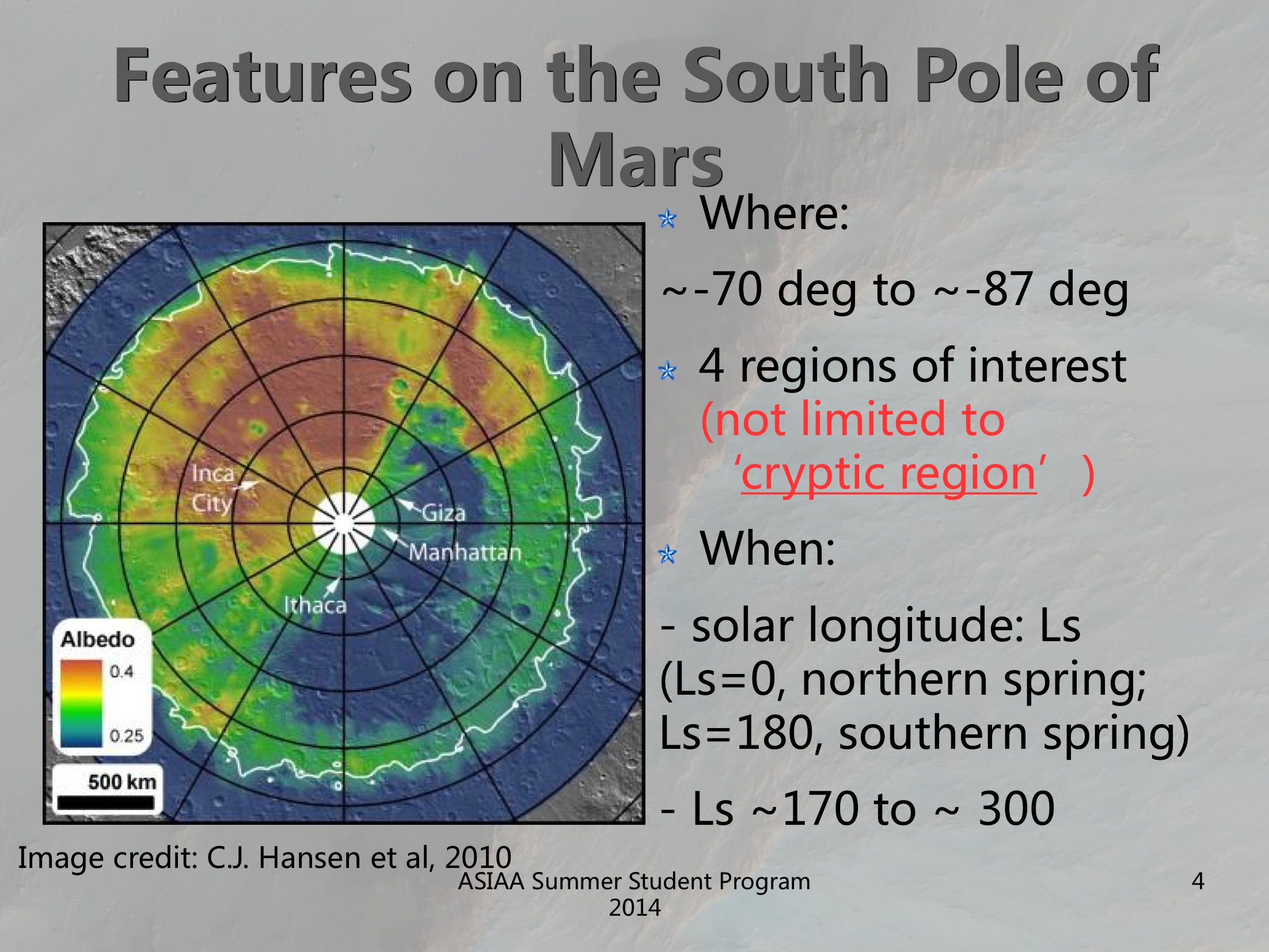 These features are everywhere from -70 to -87 deg. and not limited to the ‘cryptic region’ (low temperature because of dry ice, low albedo caused by translucent ice layer) as thought before. We use solar longitude (Ls) to measure time on Mars, these features appear from Ls 170 to Ls 300 typically.
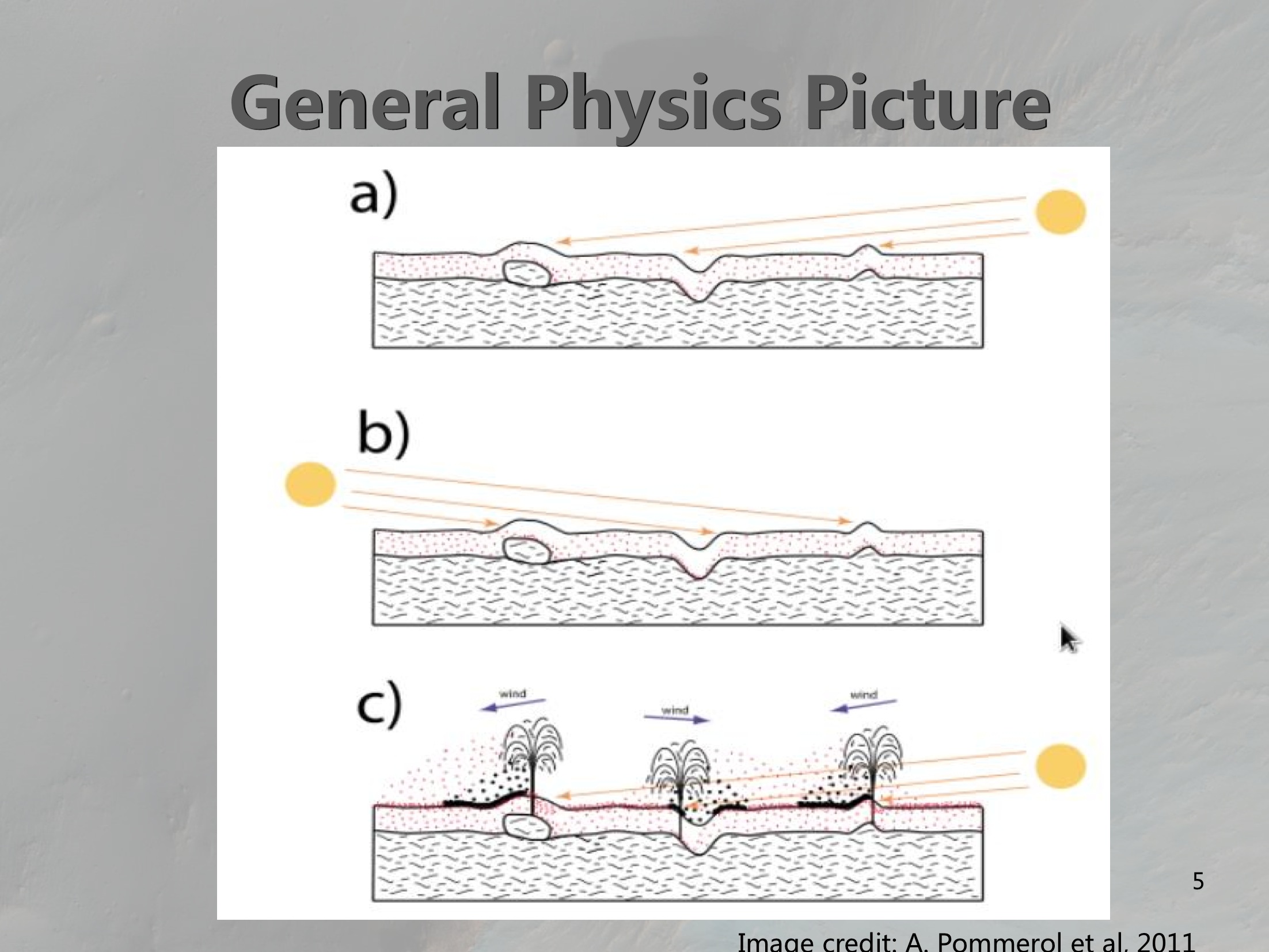 The basic idea of the formation of fans and blotches:
- In the southern winter, in the atmosphere tends to condensate and dust grains serve as condensation nuclei. They fall onto the ground with and thus are embedded in the slab ice later. In spring, they are heated by the sun and heat the surrounding ice subsequently. These ice sublimate and form bubbles which then sink through the ice layer.
- With bubbles accumulate in the bottom, pressure between ice layer and the ground increase, so the ice could break and then jets of gas, together with dust, come out.
- Due to local topography and wind, the jets form fan-shaped deposits.
The gas beneath the ice layer might carve the Mars surface and form ‘spiders’.
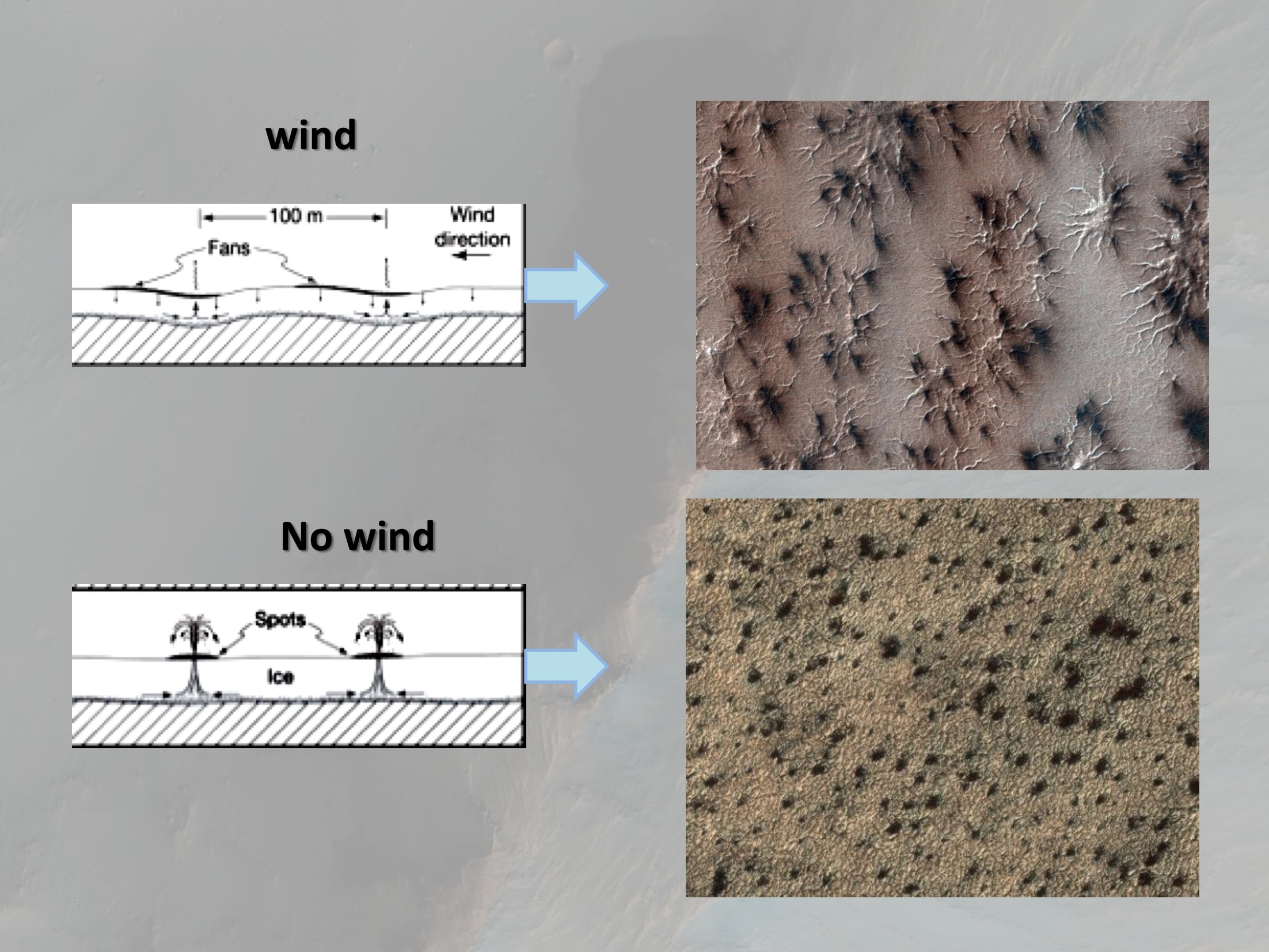 With local wind, the deposits look like fans with orientation that can indicate the direction of wind. Without wind to blow down the material, the deposits become blotches.
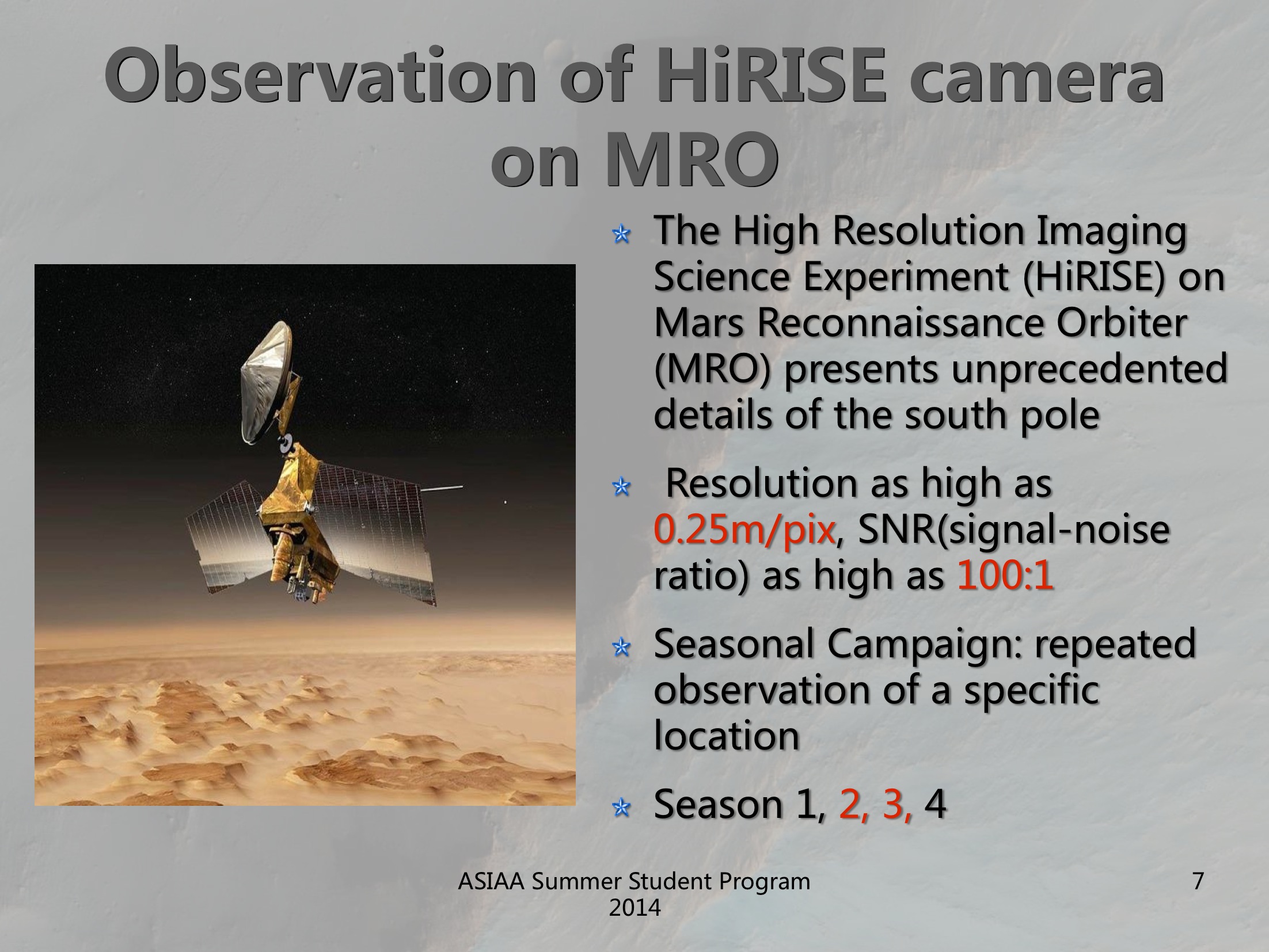 We now have a powerful instrument to study such features. The HiRISE camera on MRO has resolution as high as 0.25m per pixel and excellent SNR (100:1). So we can study sub-meter objects like boulders on Mars. It’s able to observe same locations at different time and thus show the evolution of the south pole. It has finished 4 seasons of observation. Season is 2006-2007, season 2 is 2008-2009, etc.
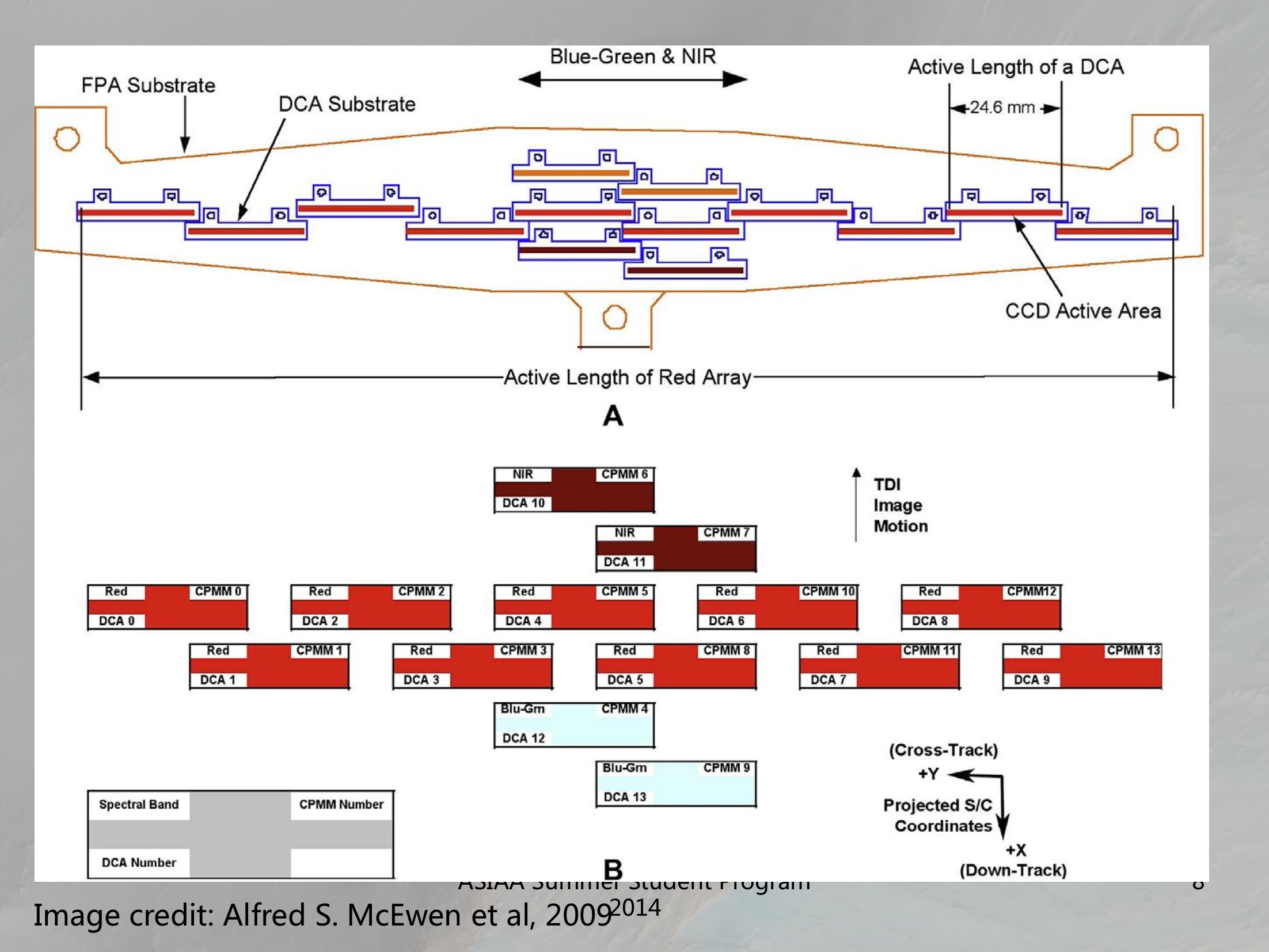 This schematic show you what the focal plane of HIRISE is like. There are 10 RED CCDs, 2 NIR, 2 BG. So color images can be obtained in the middle of the focal plane. Note that there are overlaps between every 2 CCDs.
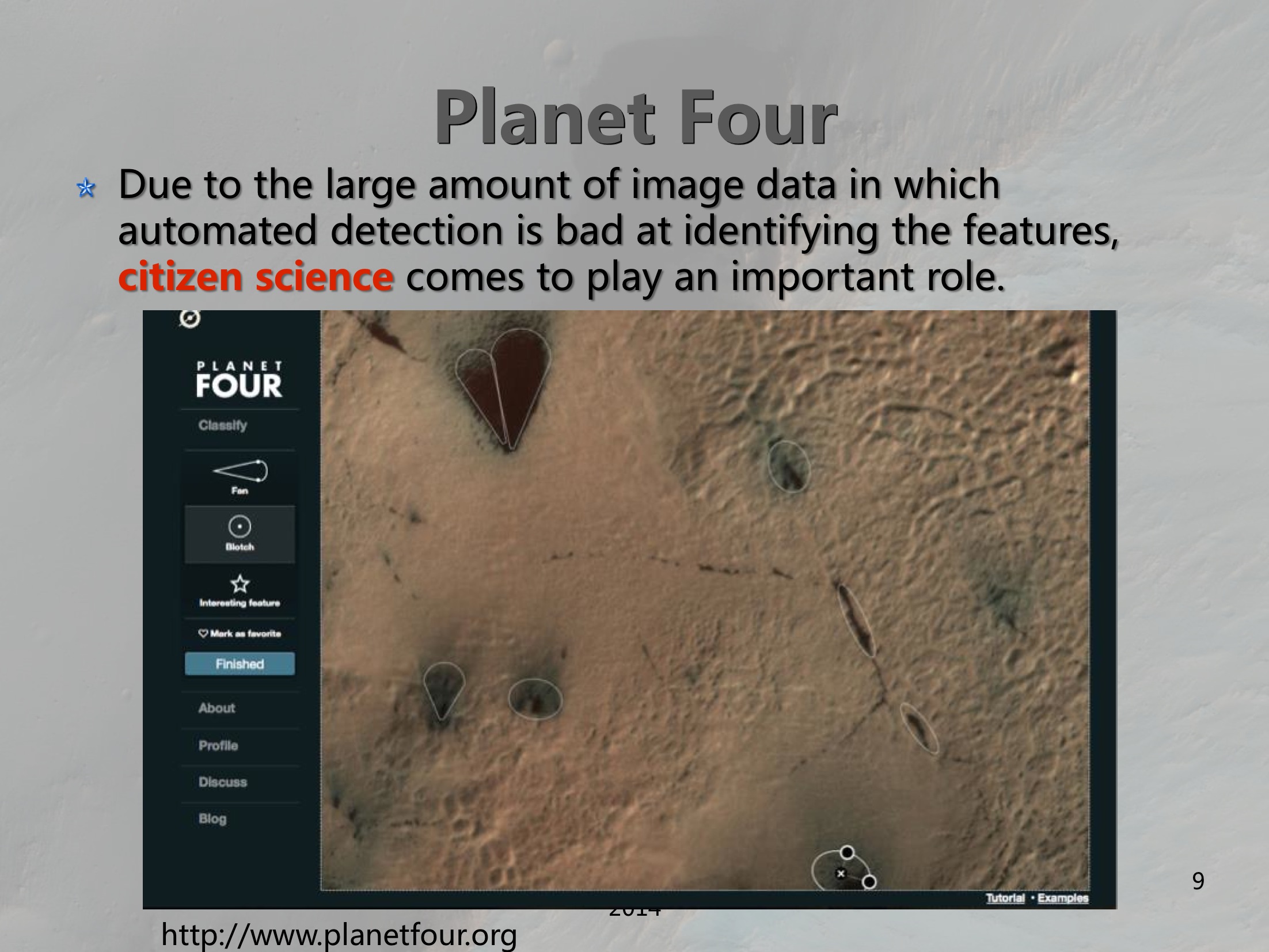 Though we have large amount of data from HiRISE, computers are bad at recognize the features in it. Thus we invite citizens on Earth to help marking them on Planet Four. It is a project under Zooniverse. Users can use the tools in the classification interface to mark features’ sources and orientation.
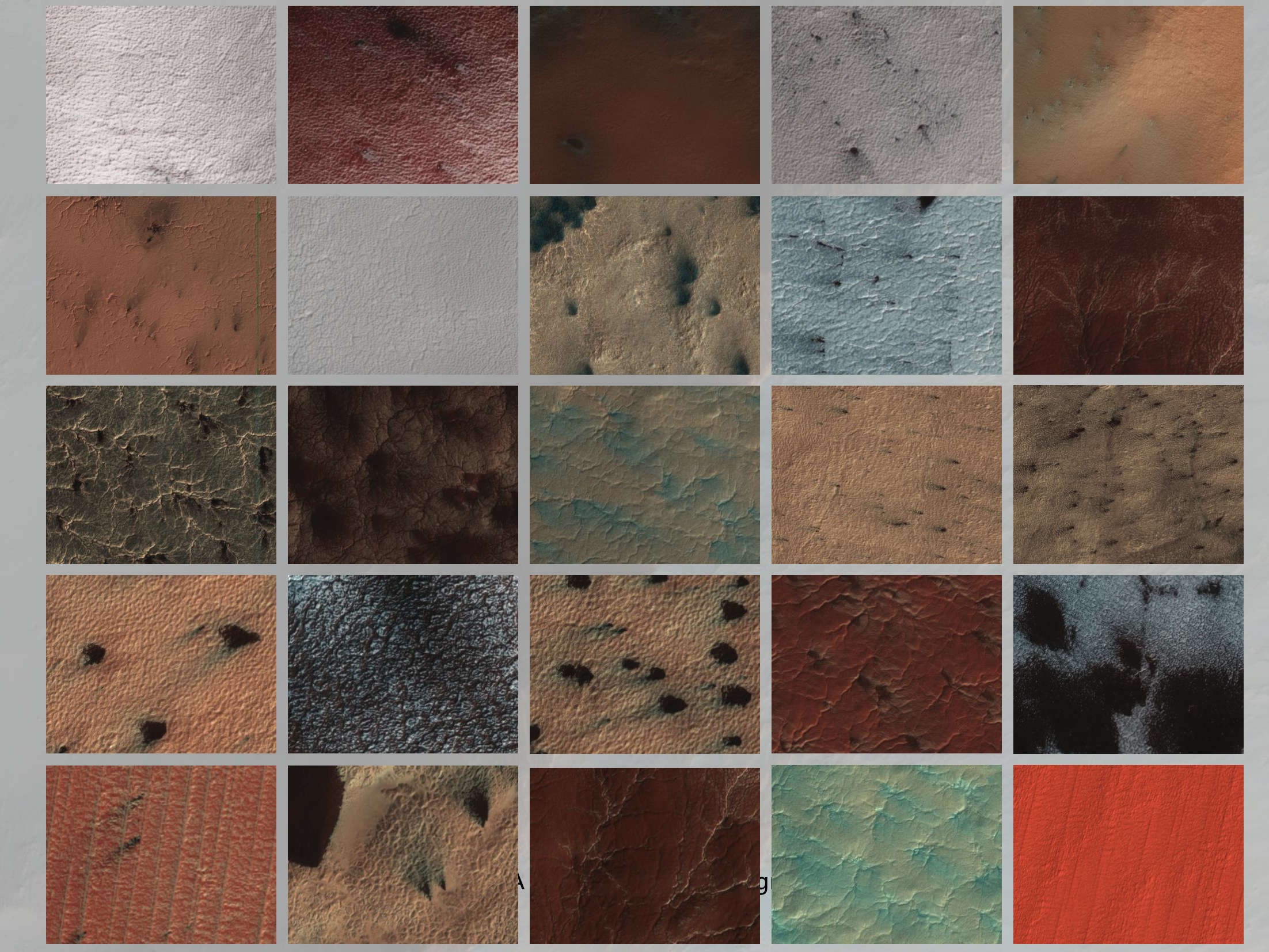 Some examples of cutouts on Planet Four.
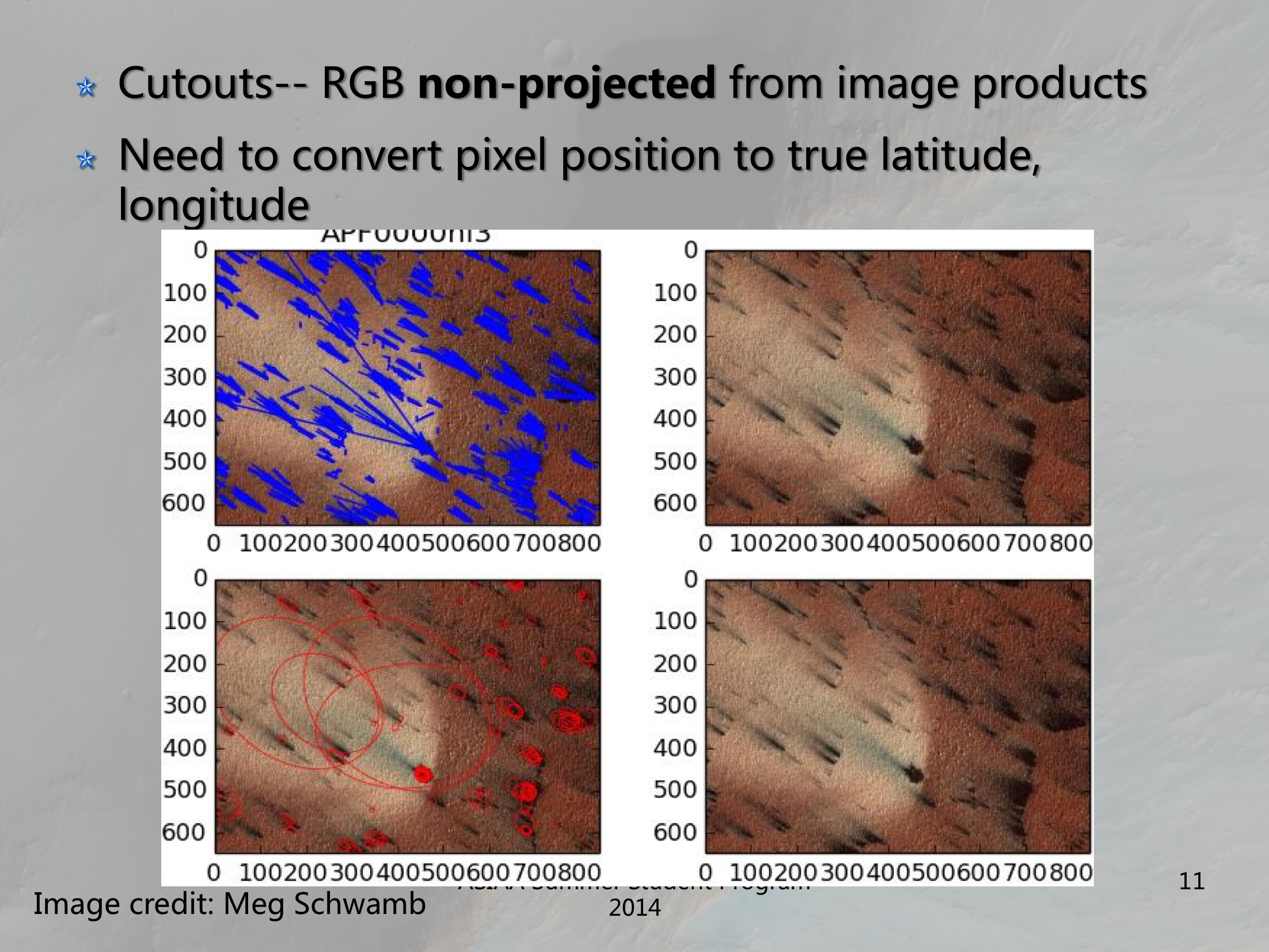 The cutouts are made from RGB, non-projected HiRISE products. Most people are able to make reasonable markings, and the clusters of people’s markings are recorded as pixel position. So we need to convert pixel position to latitude & longitude
. 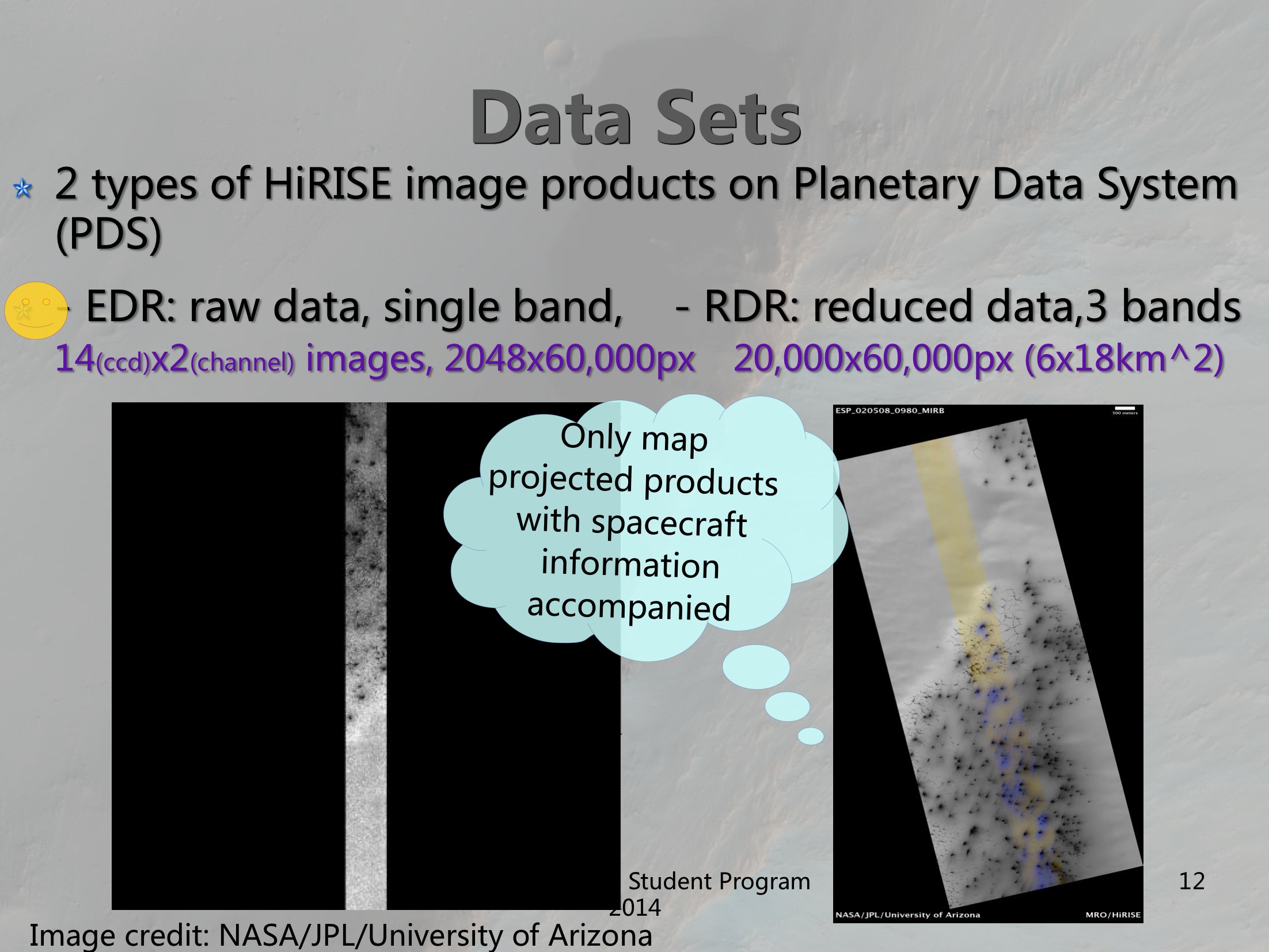 We have 2 types of data but we only use the raw data (EDR). Only map projected products of Reduced data (RDR) have spacecraft information with them. As we actually need position information of non-projected products (they are where the Planet Four cutouts come from), we decided to reassemble mosaics using raw data.
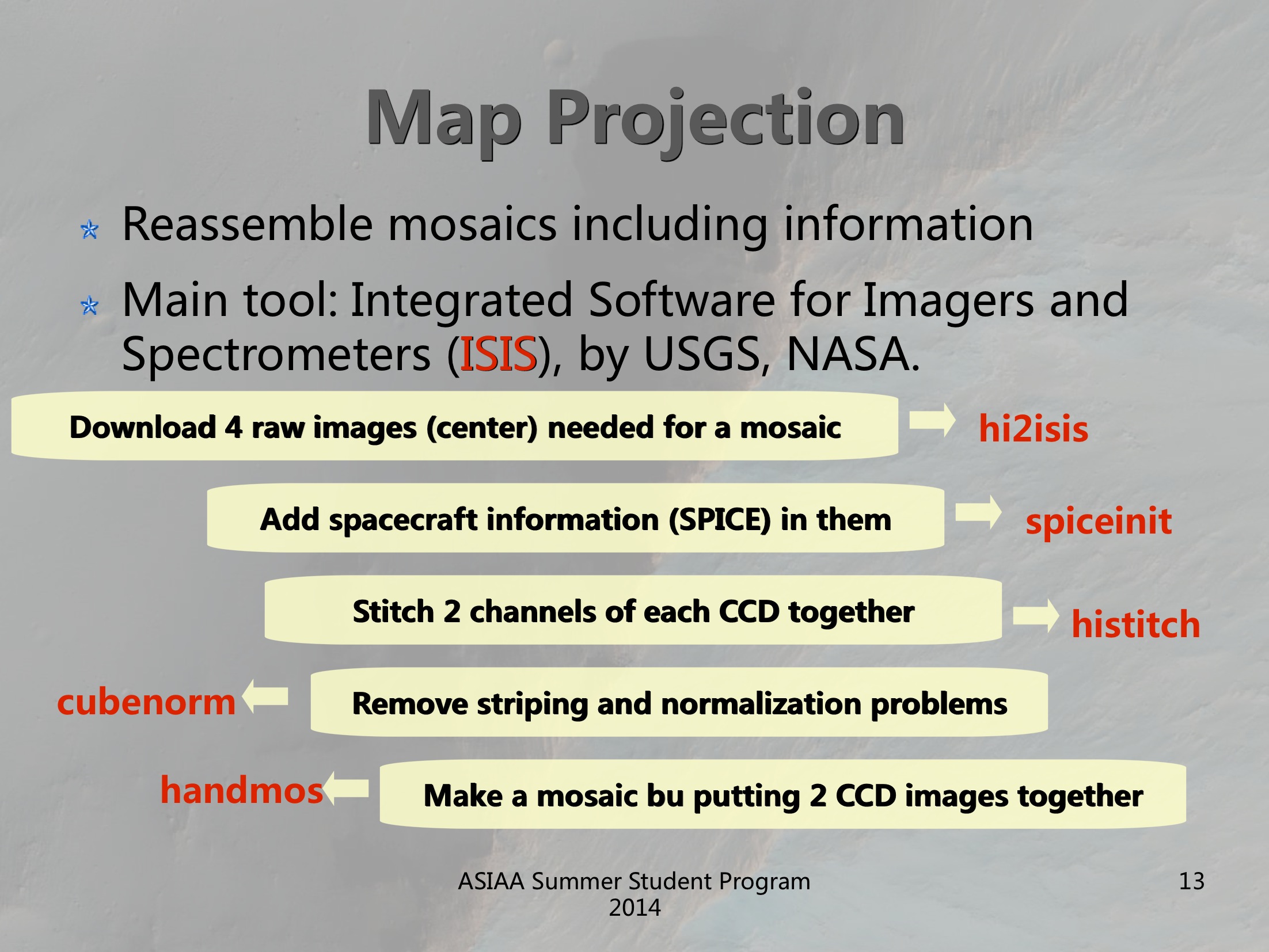
The tool we used, ISIS, is a free, specialized, digital image processing software package developed by the USGS for NASA. It is able to process data from NASA and International spacecraft missions including HiRISE. With applications in ISIS, we could follow the whole process presented here.
 The schematic of the reduction process. We developed a pipeline of it.
 Now, we are able to grab position information of any point. By getting the central points of HiRISE images, we have the distribution of them in a polar view. By drawing the images’ outlines, we show the overlap of different HiRISE images, which were taken at different periods. Study on a point in the overlap region will give the time evolution of it.
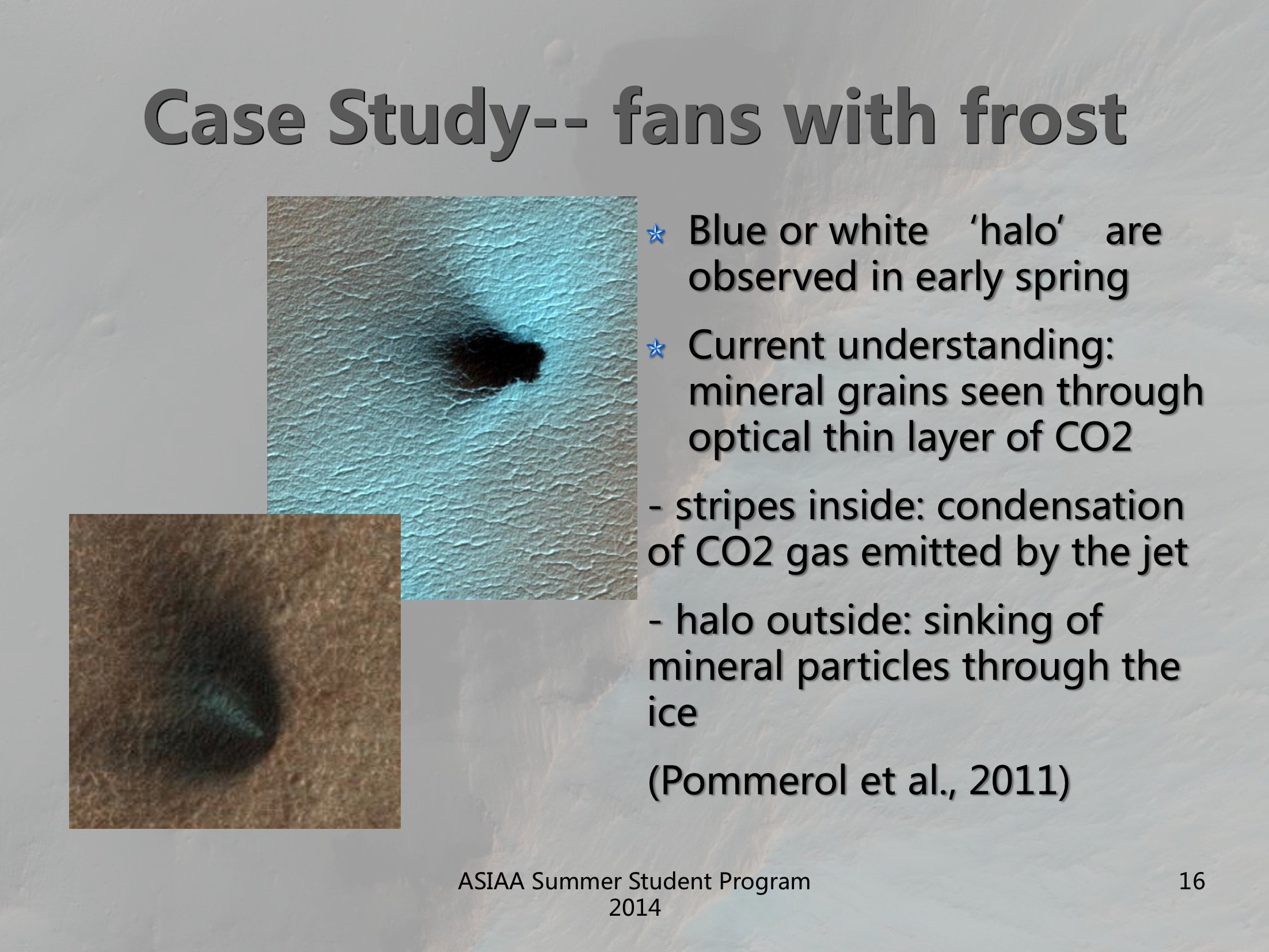 We can use these data to study fans with frost, which are common in early spring. The latest hypothesis is that the blue color is caused by a change in the structure of the ice caused the the fan particles sinking into the ice. Yet there is little evidence of it.
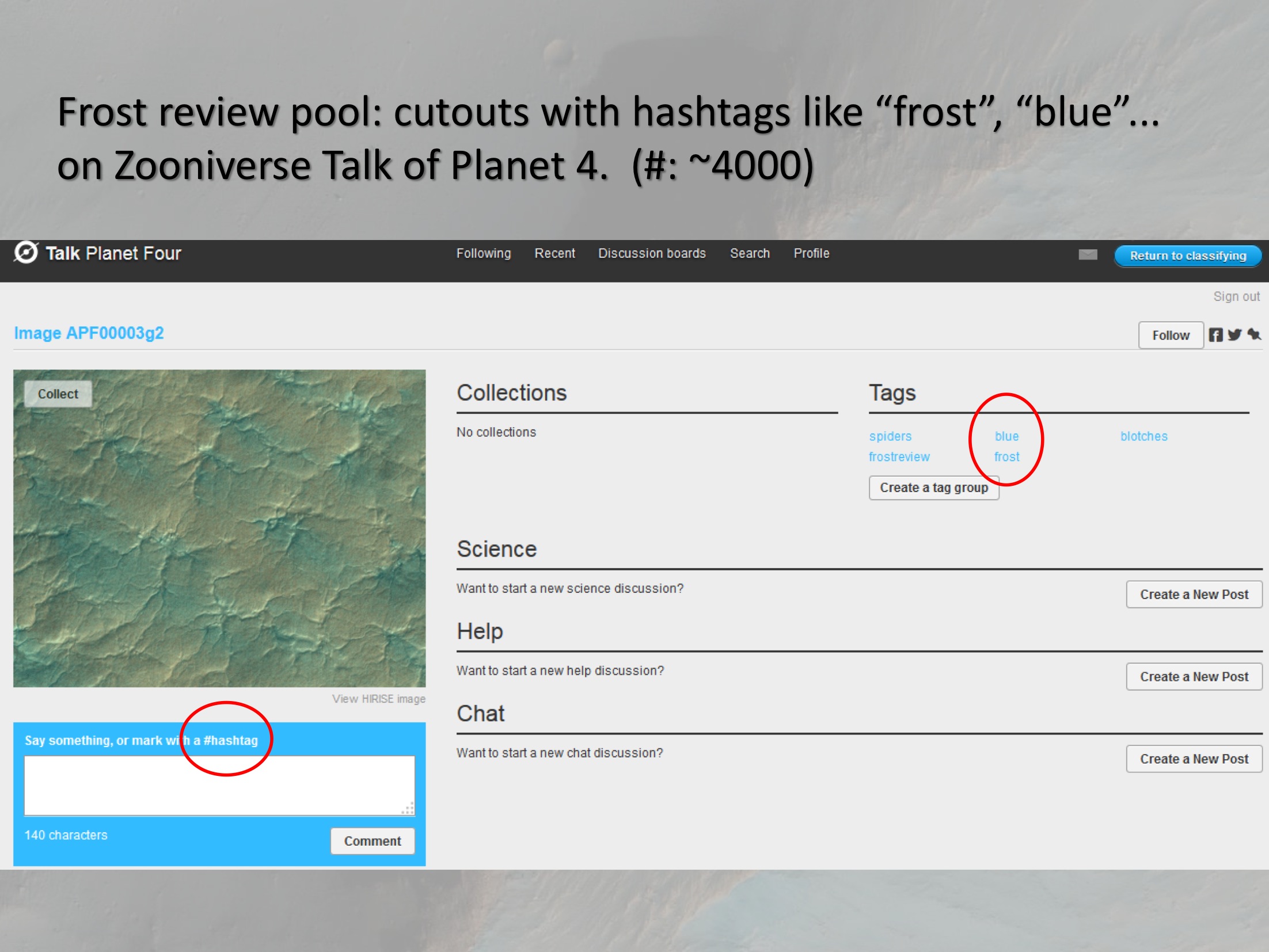 Firstly we need to review certain amount of cutouts with frost in it. The review pool is the cutouts tagged as ‘frost’ or ‘blue’… in Planet Four Talk. Though they are not all the cutouts with frost, but there are still a large amount and might contribute to revealing secrets of frost fans.
 While reviewing, we classified these frost fans, as shown in slides (18-20)

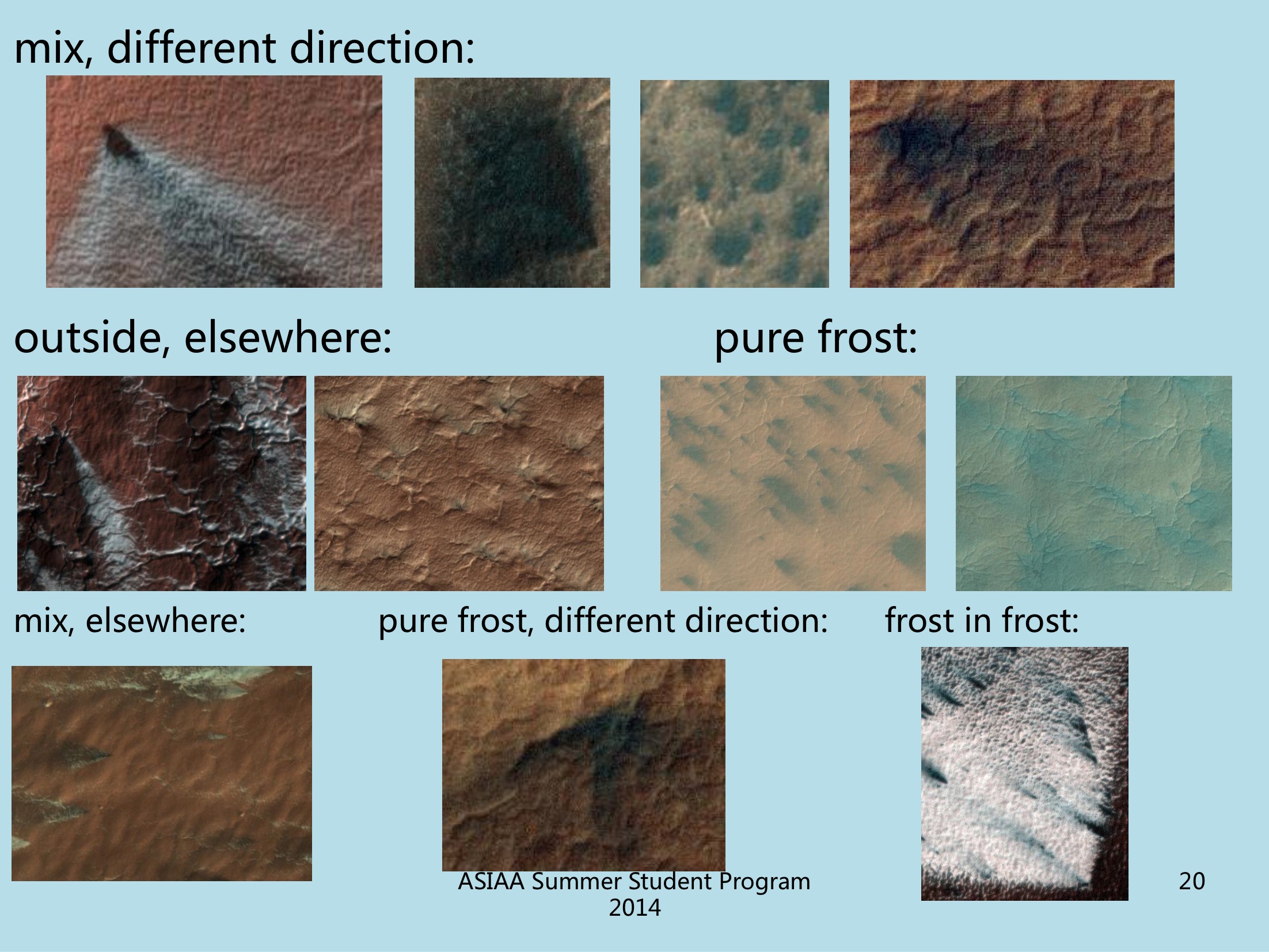
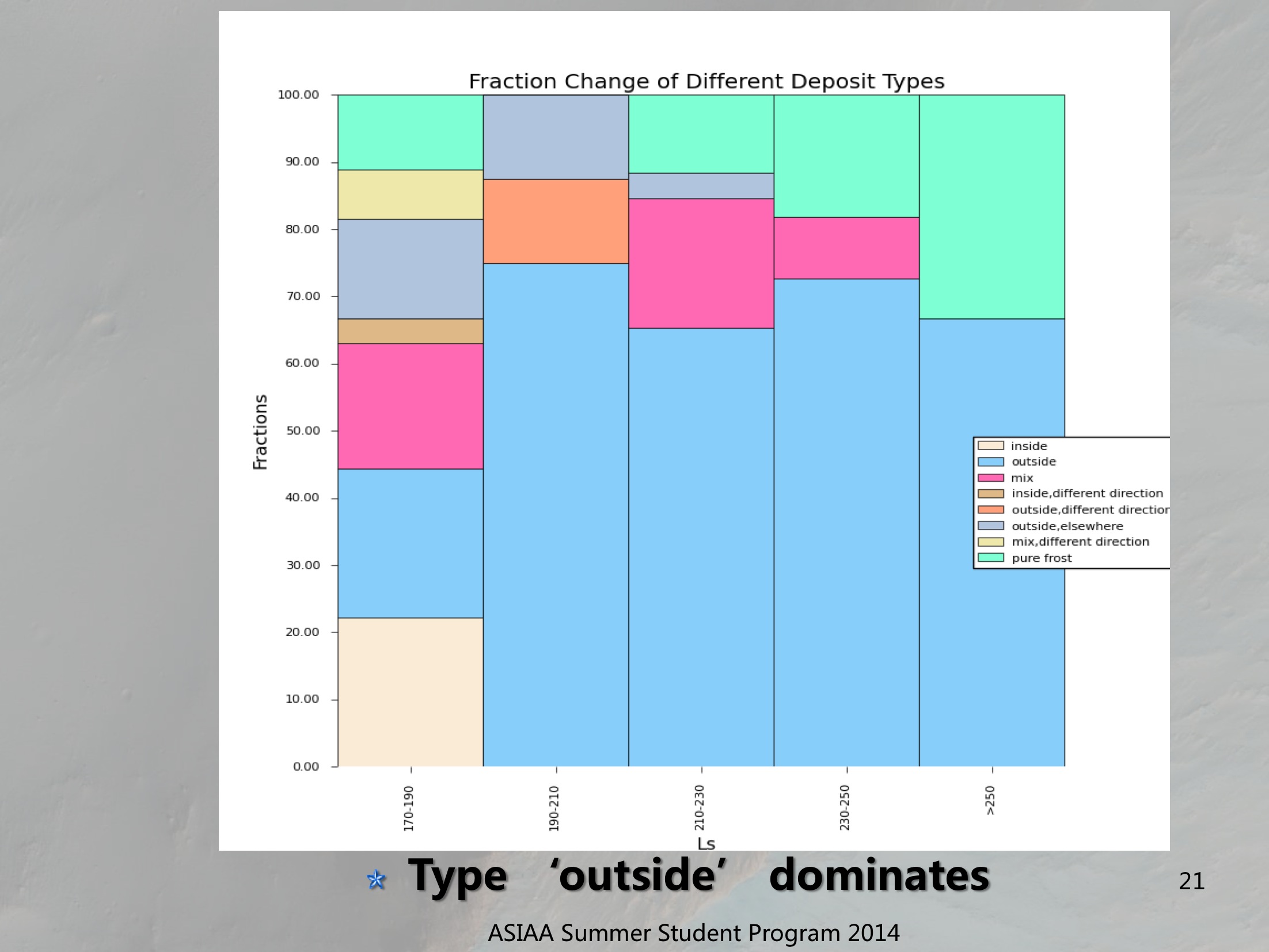 By dividing them into different periods of time, we study how the fraction of each types change over time. It can be seen clearly that type ‘outside’ dominate all the time.
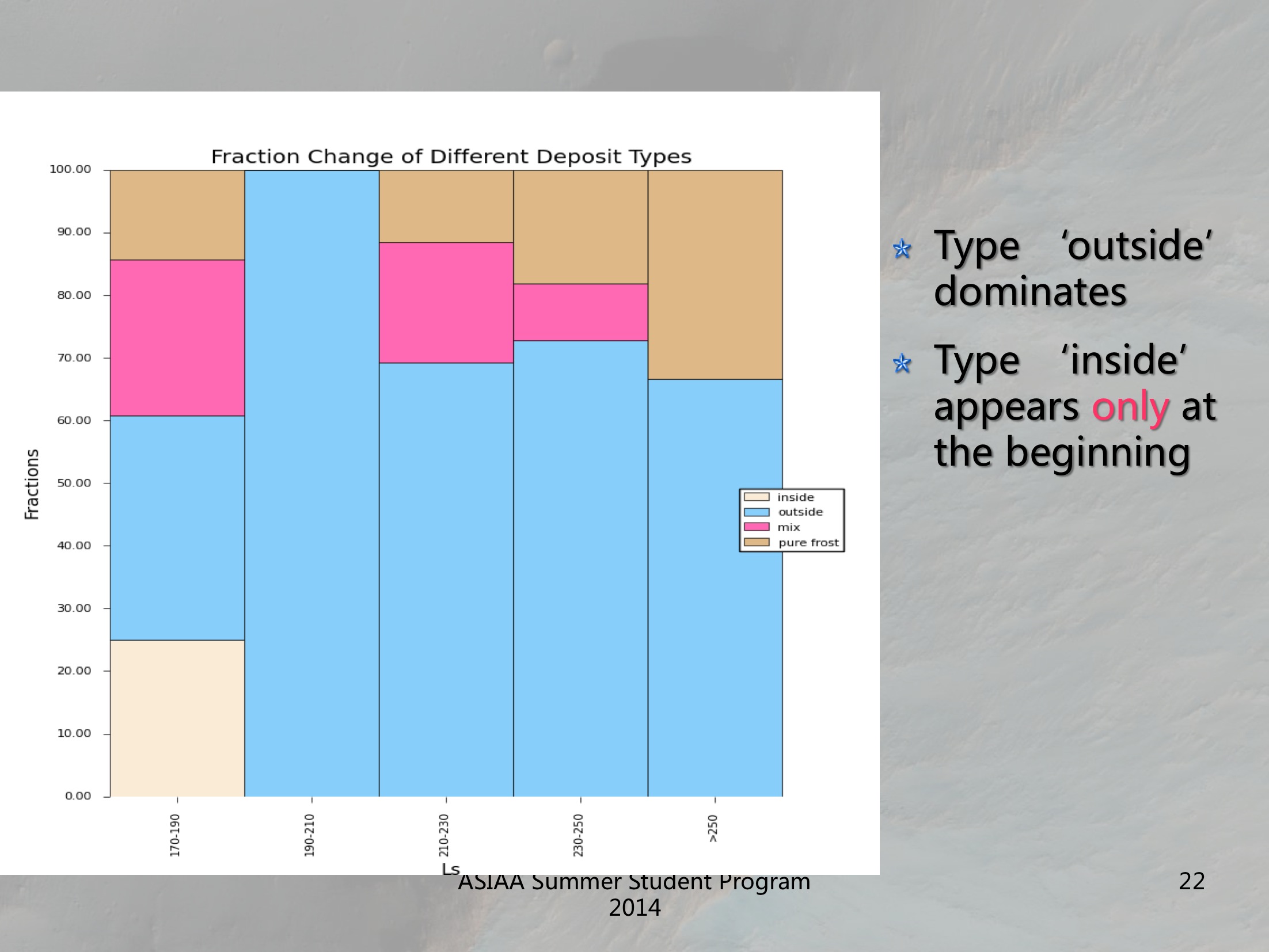 Next, we combined several types of frost fans together and took a clearer look at how the locations of frost relative to fans change. We found that frosts only appear very early and then nearly all of them become outside of fans later.
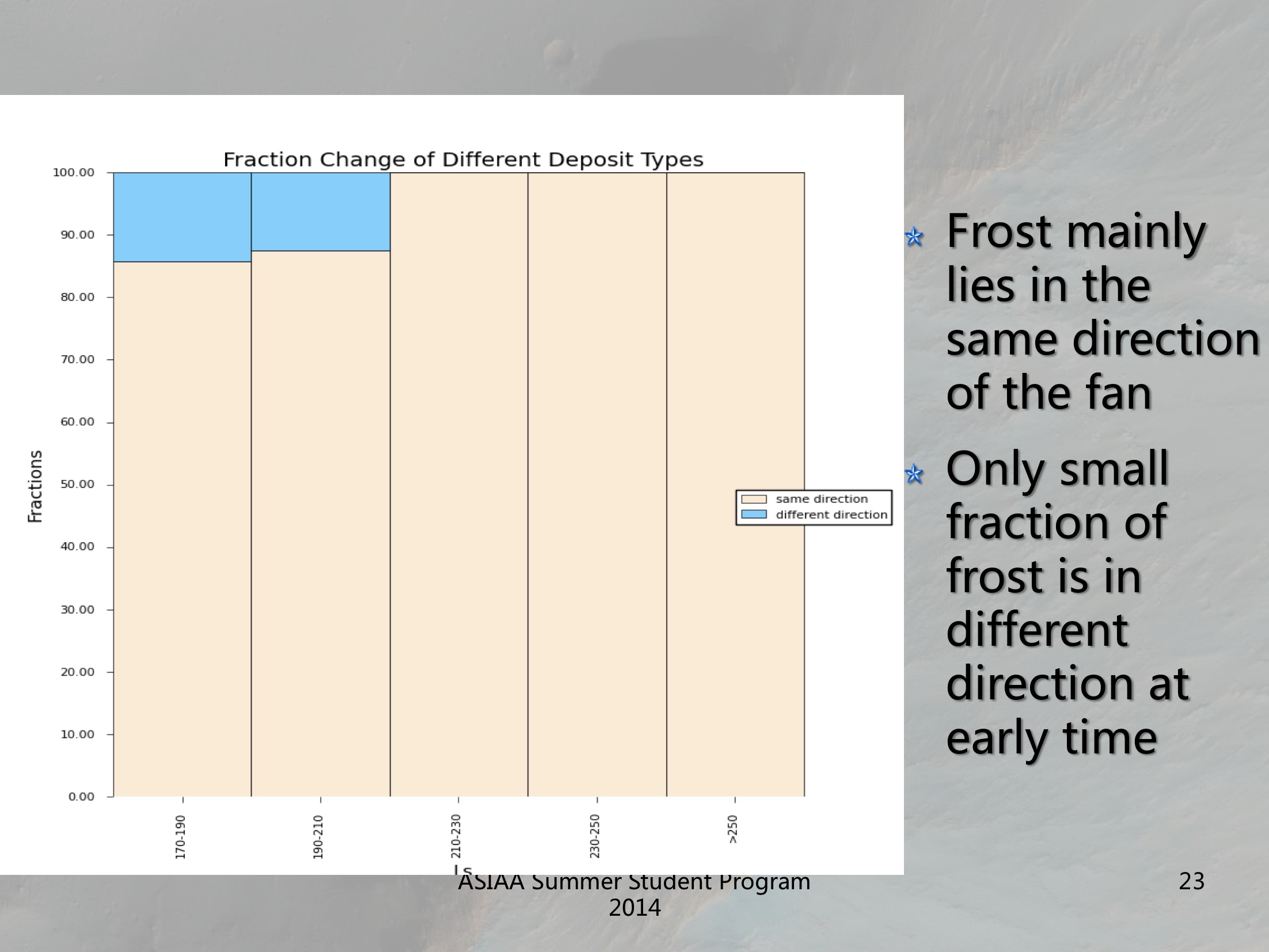 Another combining shows that frosts mainly lie in the same direction of fans, some in different directions appear early at the beginning.
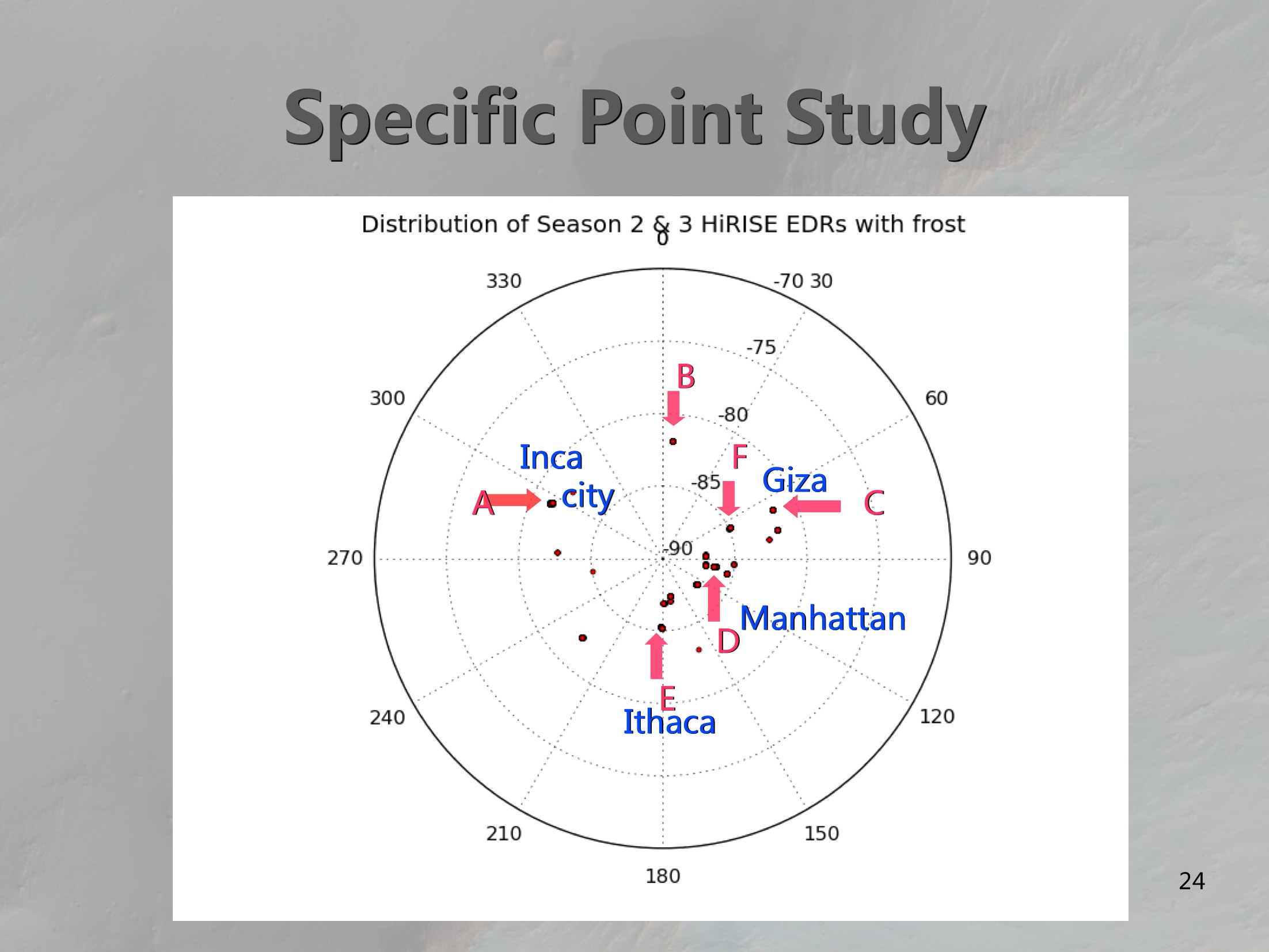 I picked 6 points of the 4 regions of interest for detailed study.
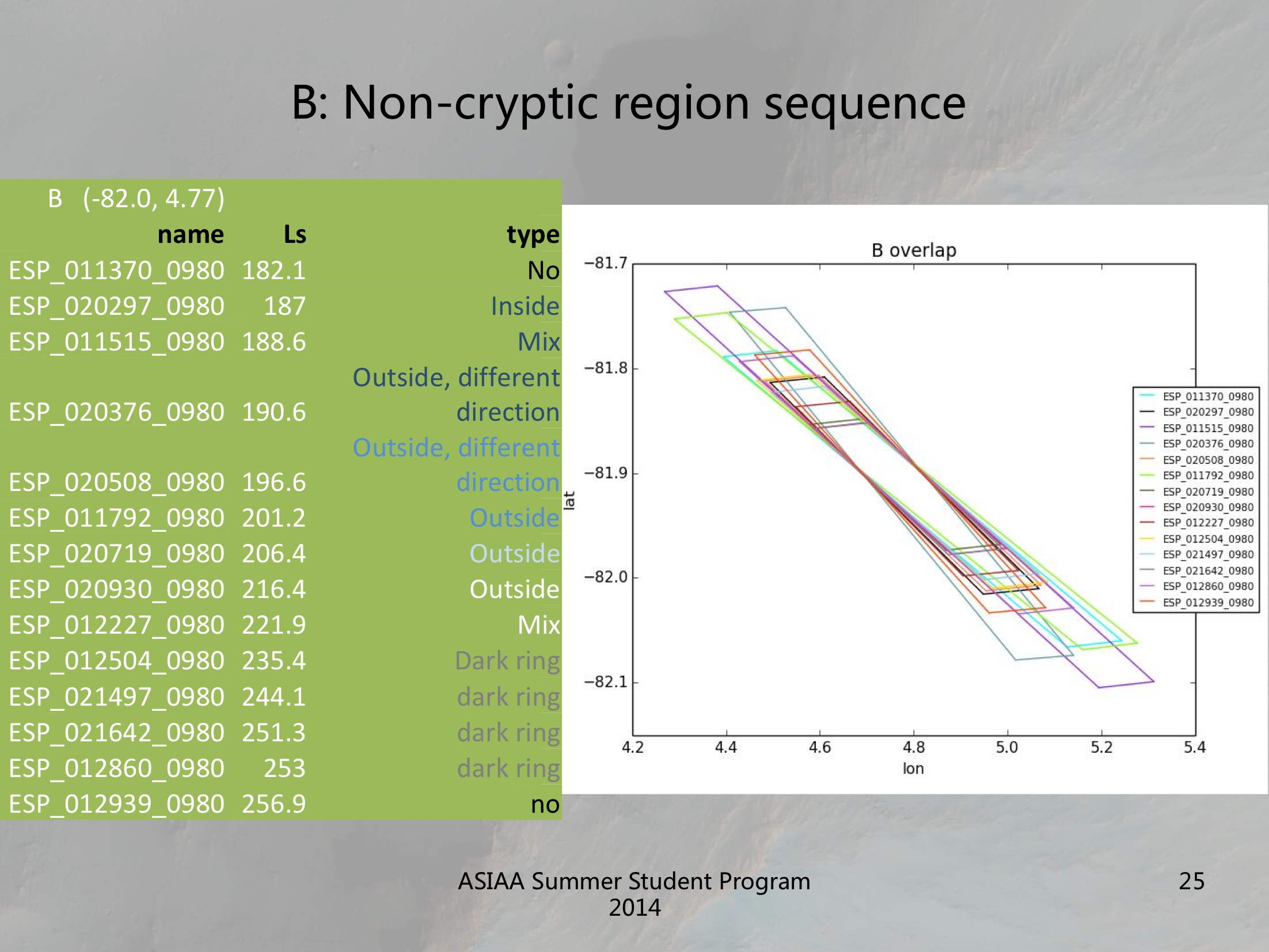 Only point B is presented since it has beautiful overlap. The table shows how the type of frost fans changes over time. Font color represents the typical color of frost or fans at corresponding time.
 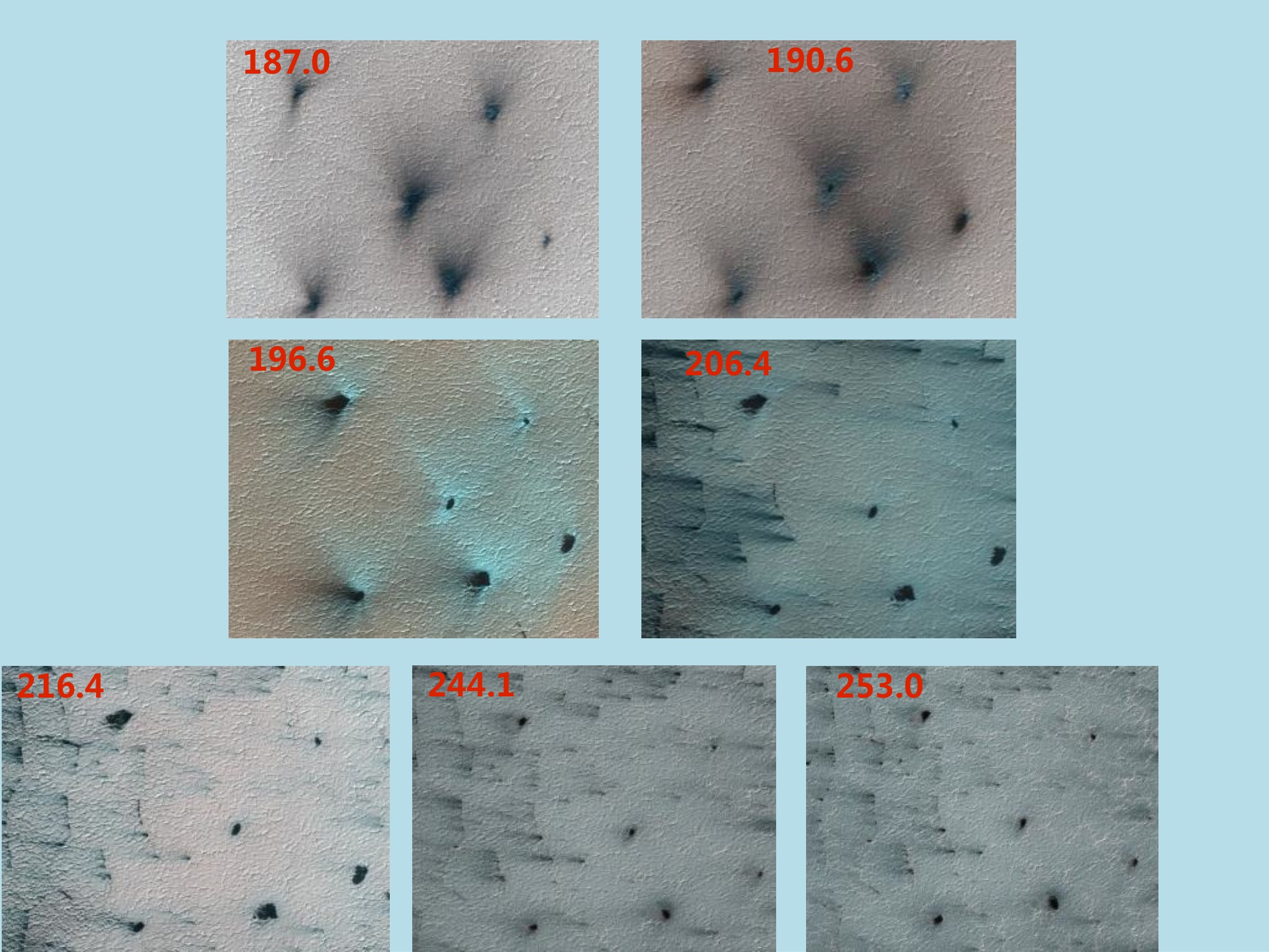 This series of pictures are of the same region. At the very beginning, nothing’s there. Gradually, we can see some dark blue stuff appear around the vents. They then expand to the outside and become bright blue. After that they begin to disappear, and the whole surface becomes white soon, with dark cores left
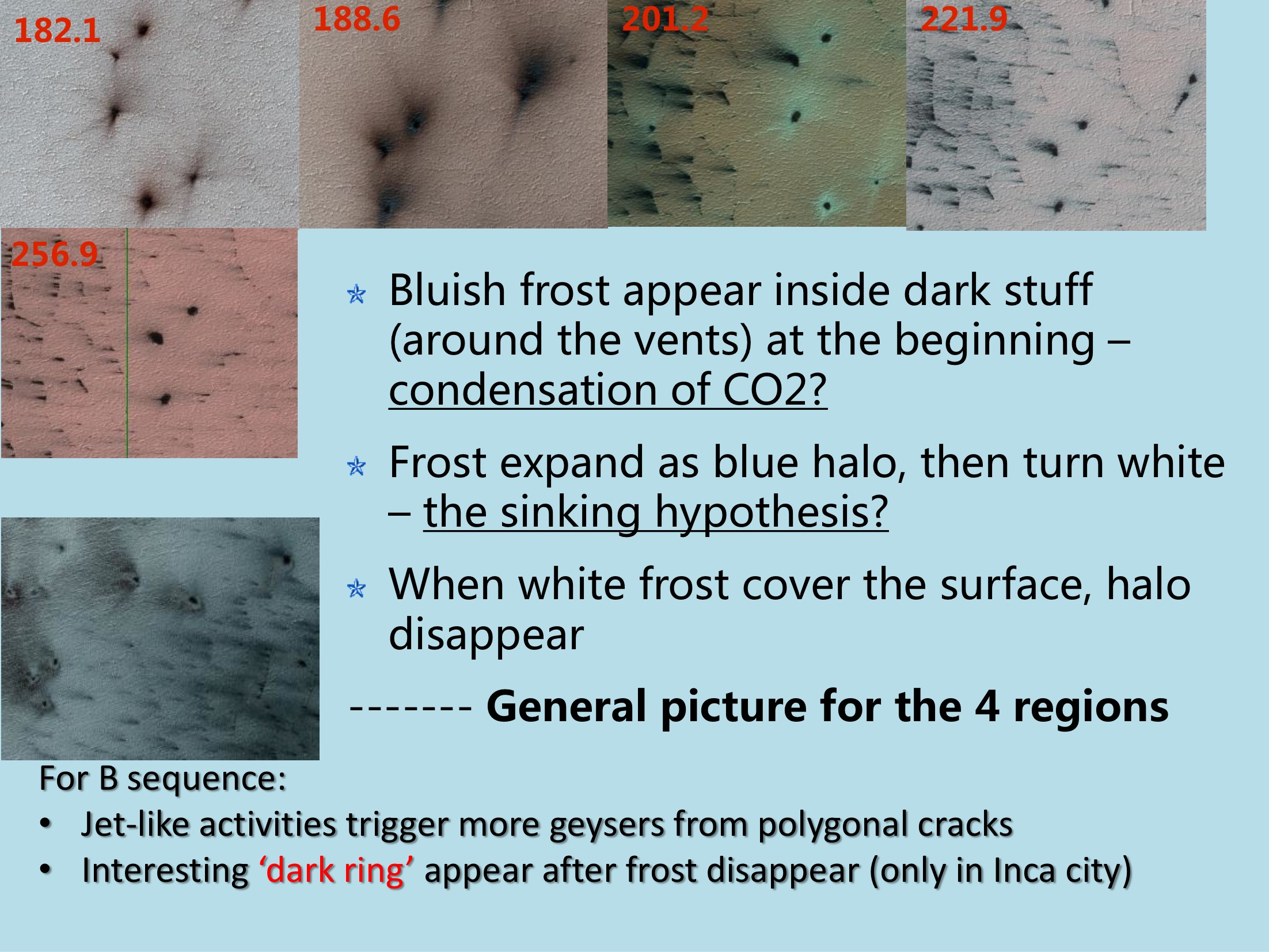 Another series show the similar process. Actually, we observe such process not just in B region. So we might have a general idea of frost evolution, as the slide shows. Interesting ‘dark rings’ are observed after frosts disappear in some places. It is the first time we see such features.
 This slide concludes my work in summer and work might do in the near future.
And the winner is….
A month ago, we asked for your help to decide which bit of the Martian South Pole (Inca City, Ithaca, or Manhattan) the world would see first to mark the start of the new season of HiRISE‘s South Pole monitoring campaign. A big thank you to everyone who voted in the Season 5 Sneak Peek vote, and many thanks to the HiRISE team and the Zooniverse team for their help as well.
The votes have been tallied and we have a winner. The winner is….

The breakdown in votes can be found below:

Inca City was the most popular choice. Inca City is known for its boulders. It will be exciting to see if there are already fans by the boulders after the early days of sunlight when the first HiRISE monitoring campaign image gets taken. Once the first observation of Inca City has been acquired and processed by the HiRISE team, it will be made ready for public release. We’ll let you know on the blog as soon as the Inca City observation has been made public.
This image is just a sneak peak of what is to come. We will have all of the South Pole Season 5 monitoring images to look forward to in the future on Planet Four, but in meantime while we wait for the Inca City’s first image, if you have some spare time today, mark seasonal fans and blotches to help us better understand the Martian climate at http://www.planetfour.org
An Introduction to HiRISE
Today we have a guest post from Chuhong Mai, an undergraduate student working on Planet Four this summer as part of the ASIAA Summer Student Program.
By now, you may have helped the Planet Four team classified hundreds of thousands of cutouts produced from HiRISE season 1 to 3 products, and you may have voted for a region target for HiRISE to be observe in season 5, however, but how well do you know about this camera that makes the whole Planet Four project possible? And that’s what this blog post is going to talk about.
The High Resolution Imaging Science Experiment (HiRISE) camera is carried on the Mars Reconnaissance Orbiter (MRO) spacecraft and since the spacecraft entered Mars orbit in 2006, HiRISE has produced a large amount of beautiful images in unprecedented detail. It was in a 2-year Primary Science Phase (PSP) during 2006 and 2007, corresponding to season 1 in Planet Four project. Later, it had two 2-year Extended Science Phases (ESP) in 2008-2009 (season 2) and 2010-2011 (season 3). HiRISE continues today to operate under an extended mission taking images of unprecedented detail. So if you notice the images’ names (not the cutouts’ names), you’ll find all of them begin with PSP or ESP, which indicates the mission phase HiRISE were in when a certain picture was taken. The rest of their names tell you some other information of HiRISE’s orbit.
The HiRISE camera mainly consists of a telescope with 50 cm diameter and a focal plane system right behind it. This plane might be one of the most important parts of HiRISE since 14 CCD detectors are installed on it, each with 2 separated output channels and 2048 pixels. 10 of these CCDs are for the Red band (RED0 to RED9), 2 are for the Infrared (IR) band (IR10, IR11) and the rest 2 are for the Blue-Green (BG) band (BG12, BG13). They overlap each other by around 48 pixels. Their positions are shown in Fig.1. So as you see, the red band will cover a much wider range (5.0-6.4 km wide) of Mars surface than the other two bands, but only RED4 and RED5, which locate at the center, can cooperate with IR and BG band to generate color products (1.0-1.3 km wide). The HiRISE team also use Time Delay Integration (TDI) to increase SNR (Signal-Noise Ratio). The basic idea of TDI is to image the same small patch of surface many times and add up together to improve SNR. Different numbers of TDI lines (8, 32, 64, 128) are used under different conditions. In addition, six pixel binning modes can be used to increase coverage and SNR, either. Click here to learn more about how binning works. On the whole, HiRISE is able to reach a high resolution: 0.25m/pixel with low SNR exceeding 100:1. This makes sub-meter surface study of Mars possible.
The three bands are selected to differentiate a broad classes of surface materials like bedrocks, frost or ice, sand, dust and other minerals and to avoid ambiguities between shades and different materials, which is often the case in grayscale products. Typically, frost and ice appear bright white and blue, sand and rocks appear bluer and darker, while the dust are the reddest material in these images. Therefore, with these bands combined together, a final color product you see are usually not a true-color images (like what you see through naked eyes), it is either an IRB product, which combines the 3 bands mentioned above, or a RGB product, which combines the Red, BG and synthetic blue band. The latter one is used by Planet Four to make cutouts for you, as RGB images usually do better in contrasting RED with BG color variations. Note again that these images are false-color products and the true Mars surface appear relatively bland and red. Sorry about that because how beautiful these cutouts are!

Fig 1. Schematic of the focal plane system on HiRISE (from A.S. McEwen et al [Reference 2])
References:
W. Alan Delamere, and 15 colleagues, 2009. Color imaging of Mars by the High Resolution Imaging Science Experiment (HiRISE). Icarus, 205, 38-52
Alfred S. McEwen, and 14 colleagues, 2007. Mars Reconnaissance Orbiter’s High Resolution Imaging Science Experiment (HiRISE). J. Geophys. Res., 112, E05S02
 Planet Four Blog