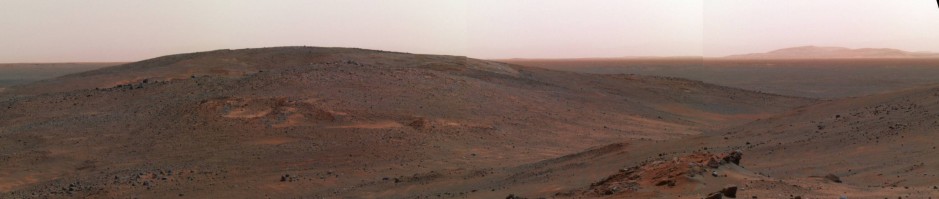
New address: Ithaca, (85.2S, 181.4E), Mars
We have recently started showing you data from a new location! Have you noticed?
This new place is called Ithaca. It is located at lat =-85.2, lon = 181.401. Unlike Inca City (our most recent focus), this is a flat area, no considerable slopes are present here. Ithaca is located in the middle of this elevation map:

You see, that the red area has maximum elevation change of less than 80 meters. In the absence of slopes, we can say more confidently that the fans here are result of interaction of dusty CO2 jets with winds and not gravity simply pulling sand downhill. Winds direct dust and sand particles after they are lifted up into the atmosphere by the jets. It is very striking, that the fans look very similar in several consequent years of HiRISE observations. The usual year in Ithaca looks like this:
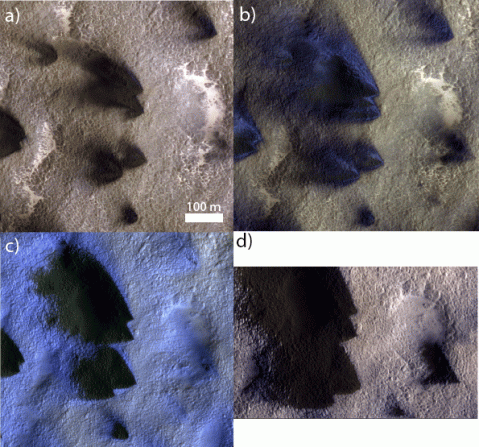
This is a mini-series of HiRISE images from early spring (a) progressing to late spring via (b) to (c) and finally to (d). Fist images that HiRISE returns each spring show large dark fans with the similar opening angles and similar directionality every year. This tells us that there is few variation in local weather from year to year.
When spring progresses, fans extend, later blue fans appear, and sometimes they take over most of the surface! Like in figure (c) – whole area is blue apart from really dark fans. This is one of the mysteries of Ithaca – we know from spectrometers, that those blue fans are fresh CO2 frost, but how comes fresh frost appears on the sides of the dark fans? Dark surface is warmer when exposed to sunlight and must prevent CO2 from forming there.
Another Ithaca mystery is its fan sizes. Here the fans grow to be huge: you see the scale bar on the first image? That is 100 m and the fans on the figure (d) are 2-3 times that long. It is larger then in most of other polar locations. For example Inca City, that must be familiar to you by now, has fans of only tens of meters. Currently scientist do not have models that is able to explain how such big fans form.
If you carefully compare left and right frames of the figure below, you can see quite some new fans appearing in the right frame.
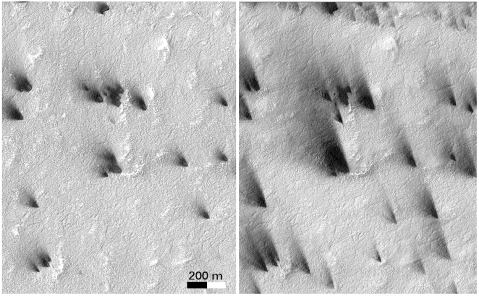
Scientists would really like to know, how many of those appear each day and how big are they compared to the old fans. In this example new fans look small, but this is only one tiny area from Ithaca. To make a clear statement we really need to count them and outline their sizes. That is why Ithaca is now waiting for you to get marking!
Enjoy!
Meet the Planet Four Team: Chris Snyder
Today we have the next installment of our Meet the Planet Four Team series, featuring Chris Snyder from the Zooniverse development team.
Name: Chris Snyder
What is your current position and where/institution?
Technical Project Manager at the Adler Planetarium in Chicago, IL, US.
Where are you originally from/where did you grow up?
I was born in Philadelphia, PA. Lived there for a bit, then in equal times Tennessee, Indiana, and Ohio until 2012 when I moved to Chicago.
In 3 lines explain what you do as part of the Zooniverse development team?
My primary task to manage development of Zooniverse projects. I also handle a large portion of ongoing project maintenance. Lastly, I spend a lot of time exploring ways of getting Zooniverse projects into the hands of more people.
Why do you find interesting about Mars?
It’s the first logical place for us to colonize in our solar system. Seems reasonable to learn as much as we can about it before we travel there!
What is your favorite movie?
Tie between The Matrix and The Prestige.
What is your favorite book?
The Name of the Wind by Patrick Rothfuss
What is the song you currently can’t get out of your head?
Just Jammin’ by Gramatik
What three albums would you bring with you to a desert island?
Ooo, that’s a tough one. Tool – Lateralus, Pendulum – Immersion, and Metallica – The Black Album
Favorite cocktail or beverage?
Bells Oberon. Sorry, not much of a cocktail drinker!
Meet the Planet Four Team: Anya Portyankina
Inspired in part by the Meet the Team on the Daily Zooniverse, we’re planning a series of posts to help you get to know better some of the people behind Planet Four. Our first Meet the Planet Four Team entry is devoted to Anya Portyankina from the Science Team.

Image credit: The Planetary Society
Name: Ganna (Anya) Portyankina
What is your current position and where/institution?
I am currently a Research Associate at LASP (Laboratory for Atmospheric and Space Physics) at the University of Colorado in Boulder.
Where are you originally from/where did you grow up
I was born in the USSR but grew up in Ukraine.
What are your research interests/what do you work on?
I am interested in different active processes in our Solar System that involve ices. Ice-covered comets, polar regions of Mars, icy satellites of giant planets – in all these worlds interactions of ice with atmospheres, sunlight and other heat sources bring to life exciting exotic phenomena.
In 3 lines explain your PhD thesis?
My PhD thesis is about interaction of Martian polar ices with the atmosphere. The large part of it is about observations and modeling of cryo-venting – exactly what Planet Four is about. Another part is about polar clouds that are created at times when seasonal polar caps sublimate in spring.
Why are you interested in Mars?
I find Mars exciting because despite it is an alien and still mostly unknown world it it similar enough to our home planet and it can be reached by humans in not too remote future. Feels nice to work towards that goal.
What is your favorite movie?
“Into the wild” directed by Sean Penn
What is your favorite book?
This one is the toughest questions for me! I can probably reduce my absolute favorites to 3: “Definitely Maybe” by Strugatsky brothers (Soviet time SciFi novel), “The Master and Margarita” by Mikhail Bulgakov, and “Love in the Time of Cholera” by Gabriel García Márquez. They are so different that it is hard even to compare them, not speaking of ranking…
What is the song you currently can’t get out of your head?
“Rock’n’roll Nerd” by Tim Minchin
What three albums would you bring with you to a desert island?
Something jazzy, like Jeff Healey “Among friends”, something with a swing like Robbie Williams “Swing when you are winning”, and something good for dancing on the beach like DLG’s “Gotcha!”, but I’d rather have a radio!
Favorite cocktail or beverage?
Since I have moved to Boulder – definitely beer.
More about Planet Four Translations
Üdvözlünk a Planet Four oldalán! 欢迎光临第四行星!Willkommen bei Planet Vier! 歡迎光臨第四行星!
You might remember that Planet Four is available in traditional and simplified character Chinese, but did you know the site is also available in German and Magyar(Hungarian)? We wanted to share a little bit more about some of the people who’ve helped make these translations possible.
Ning Ding helped verify the science content of the simplified Chinese character translation. Here’s more about Ning in English and in simplified character Chinese:
Ning Ding is a Ph.D candidate of China University of Geosciences (Wuhan) major in structure geology.She is mainly interested in the central uplifts of Martian impact craters and comparative planetology. She was a visiting student in HiRISE team in the US where she knew the Planet Four and participated in Chinese translation the website.
Lukas Hackl helped translate Planet Four into German . Here’s more about Lukas in German and English:
My name is Lukas Hackl. I am from Austria and working for an IT company. I am interested in Astronomy, Photography, Motorcycle and other science. I like to be part of researches and help scientists around the world.
Mein Name ist Lukas Hackl. Ich komme aus Österreich und arbeite für eine IT-Firma. Ich interessiere mich für Astronomie, Fotografie, Motorrad und andere Wissenschaften. Es gefällt mir Teil von Forschungen zu sein und Wissenschaftlern auf der ganzen Welt helfen zu können.
Szatmáry László helped translate Planet Four into Hungarian/Magyar . Here’s more about László in Magyar and English:
So, I’m an Application Specialist in a Hungarian software company and a beginner amateur astronomer. I’m participated in numerous Zooniverse projects and I think it is a great way to help science and scientist in their works. I have only one bigger experience in translating, I was one of the Hungarian translators of Chess.com. I’m interested in sports, chess, stars and environment defense.
Alkalmazástechnikai szakember vagyok egy magyar szoftvervállalatnál illetve kezdő amatőrcsillagász. Több Zooniverse projektben is részt veszek, szerintem ez egy hatalmas lehetőség a tudomány és tudósok segítésére. Jelentősebb fordítói tapasztalatom eddig a Chess.com magyarítása volt, itt egy voltam a többi fordító között. Érdekel a sport, a sakk, a csillagok és a környezetvédelem.
Are you interested in helping translate Planet Four into other languages? Find out more here on how to join the effort.
Gold Standard Data

Image Credit: Wikimedia Commons http://en.wikipedia.org/wiki/File:Gold_Bars.jpg
We wanted to give you a quick update on what the science team is up to. We’ve been hard at work making progress towards the goal of completing the project’s first paper, thanks to your help marking the fans and blotches in the season 2 and season 3 cutouts. Fingers crossed, we aim to submit the paper to a scientific journal by the early Fall.
We’ve been working on developing the best method to combine your classifications to identify blotches and fans in the cutouts you see on Planet Four. About 30-100 people look at each cutout, and we need to combine those markings together to get the exact locations and shapes of the seasonal features. This is one of the aspects the team is thinking about, but one of the other things we’ve started working on is looking at how well the project can identify fans and blotches in the images. You might think that this is obvious just looking at the images that the dark fans pop out on the screen, but for the paper we need to prove this is true. This is important because if we want to look at how carbon dioxide geyser/jet activity changes over time, we need to be able to show that the project as a whole can really identify most of the fans and the blotches in the cutouts we show on the site.
Some of the other Zooniverse projects have compared to simulated or synthetic data that was shown and classified on the site (so they knew what the right answer was for the synthetic data) or there was already a catalog of a portion of the data that could be used to compare to. It’s difficult to make a simulated HiRISE image with fans. As you’ve seen from the images, there is so much variation in color and texture of Mars and same with the the shapes, sizes, and even color of fans that this would be likely be impossible to get just right. So what about a previously made catalog of a small subset of the data we’re showing on Planet Four? There are so many blotches and fans that no one has attempted this on a large enough scale for us to fully compare the results from Planet Four to. Planet Four really is making the first map of these dark seasonal features in the HiRISE monitoring images of the Martian South Pole. The science team didn’t even know at launch exactly how frequently in the images you’re looking at on the site that you’ll see fans and blotches. You clicks are telling us the answer.
Even if there was such a catalog of fans and blotches to compare to, it would be done in a different way (not done using the web interface we have for Planet Four) that likely has its own biases towards detection and non-detection of the seasonal features. So what do we do? Well, the science team can make our own ‘gold standard‘ dataset by classifying a small subset of the cutouts we showed for Season 2 and Season 3 (a few % of the entire Season 2 and Season 3 cutouts) in the interface and use those markings in the same way as a catalog. Candy, Anya, and Michael have stared at many many images of fans and blotches from HiRISE, and I had one of my graduate preliminary exam project on mapping the fans and blotches in images from a previous lower resolution camera (Mars Orbiter Camera – MOC). So we can argue that we should be able to identify fans and blotches reasonably well in the Planer Four images and use our markings to create a catalog which we are calling the gold standard dataset. Other Zooniverse projects, such as Snapshot Serengeti, have done something similar.
Right now, we’re going through a mostly random selection of cutouts from Season 2 and Season 3, marking the fans and blotches we see with the same classification interface on the Planet Four website. To get a large enough sample of cutouts reviewed, we’re each mainly marking different cutouts than each other, but we do have a small amount of overlap for us to compare our results to each other and understand the differences. For example, I’ve looked at less images of HiRISE fans than the rest of the science team, that might make me more liberal with my markings than say Candy or Anya. The overlap should help us understand and calibrate for those kinds of effects between the different science team markings.
It might seem like we’re testing you but we’re really testing the project. This gold standard dataset is going to help us explore and show how well Planet Four as a whole can identify the seasonal fans and blotches in the images from HiRISE. Without the analysis and comparison to the gold standard data, we would just have a catalog of fans and blotches on the surface. The comparison to the gold standard data is a really vital part of the project, and allows us to study how the Martian climate impacts the formation of the seasonal blotches and fans from Martian year to year and throughout a given season.
We’ll keep you posted about the gold standard data and our analysis as it continues to develop. Stay tuned to the blog for more updates about the paper as we get further into the Summer.
Planet Four Now Available in Simplified Character Chinese
欢 迎光临第四行 星!We’re pleased to announce that Planet Four is now available in simplified character Chinese. Thanks to the efforts of the Education and Public Outreach (EPO) Office and Zheng Meyer-Zhao at the Institute of Astronomy & Astrophysics, Academia Sinica (ASIAA) in Taiwan. Also a big thank you to Chris Snyder from the Zooniverse’s development team at Adler Planetarium for all the technical help and to Ning Ding at the Lunar and Planetary Laboratory at the University of Arizona for help verifying the translation. Below is a note from Zheng Meyer-Zhao and some info about the site both in simplified Character Chinese and in English:
Zheng Meyer-Zhao
I am a software engineer at ASIAA, born and raised in the north-east of China. It has been my pleasure to participate in the translating efforts the Planet Four website to simplified Chinese. During the Citizen Science workshop organized by Meg in March 2014 at ASIAA, I learned that many people worldwide are joining this great project in their spare time to help out scientists. However, there are not many people participating from China yet. The main reason of this is the availability of the information, as there was no Simplified Chinese site available. The simplified Chinese version of Planet Four provides a perfect opportunity for people in China to join the exciting cutting-edge project to enjoy and experience the amazing images of Mars.
赵征
我是中研院天文所的软件工程师,生长于中国东北。我很荣幸能帮助第四行星翻译简体中文网站。2014年三月,Meg 在 中研院天文所组织公众科学研讨会。从一个星期的研讨会中,我了解到, 来自世界各地的志愿者朋友们利用他们的闲暇时间参与宇宙动物园的项目,来帮助科学家们分类海量图像,可是却还没有很多国内的志愿者朋友参与。这其中主要的 原因是缺乏相关讯息,因为宇宙动物园的项目还没有简体中文网站。前一段时间Meg请我帮忙翻译第四行星的网站,我欣然答应。希望第四行星的网站可以给国内的志愿者朋友们提供一个了解火星的平台,让更多的人能够参与这个令人兴奋的项目,体验前所未有的精彩火星图像。
欢迎光临第四行星!
欢迎光临「第四行星」。行星科学家正在计算测量火星地表特征,很 需要你的辨识和协助。在此和你面对面的火星地表图像非常独特,绝对都不会在地球上出现,因为每张图像都取自火星的南极!对火星南极这块陌生区域,我们的了 解仍极有限,其中大部分是人类未曾亲眼见到过的火星景象!
请问我要帮忙找啥?
我们需要你帮忙找出火星地表上的「扇形」和「暗斑状」的图(以下简称「扇形」、「暗斑」),并且用框线的方式做出标识。科学家认为这些形状特征代表 风向和风速。只要持续追踪「扇形」和「暗斑」,经过几个火星年后,我们将会渐渐知道这些特征是如何形成、发展以及它们会怎样消失和变化,这能帮助行星科学 家深入了解火星气候。此外,如果相同特性总在相同地点形成,也将有机会认识到这些地表特征会怎样在经年累月后发生变化。
为什么需要这么多人帮忙?
卫星采集回来的火星照片数量庞大,这些需要分类的工作若光靠少数科学家自己做,做不完!而电脑对图像辨识标记这件事,几乎帮不上忙。老实说,人脑能处理的复杂性分析,当然远超过辨识这些火星图像!不是吗?
想知道关于你标识的每幅图像的结果我们会如何处理吗?我们会把所有志愿者的标识结果都放在一起。经过加总平均运算机制,产生一个完整可靠的火星地表「扇形」和「暗斑」总地图,首度完成火星大规模风向风速测量计划!
Welcome to Planet Four!
Welcome to Planet Four, a citizen science project designed to help planetary scientists identify and measure features on the surface of Mars . . . the likes of which don’t exist on Earth. All of the images on this site depict the southern polar region, an area of Mars that we know little about, and the majority of which have never been seen by human eyes before!
What am I looking for?
We need your help to find and mark ‘fans’ and ‘blotches’ on the Martian surface. Scientists believe that these features indicate wind direction and speed. By tracking ‘fans’ and ‘blotches’ over the course of several Martian years to see how they form, evolve, disappear and reform, we can help planetary scientists better understand Mars’ climate. We also hope to find out if these features form in the same spot each year and also learn how they change.
Why do you need our help?
There are far too many images for a group of scientists to get through alone and computers are just no good at detecting the features we are trying to mark. The human mind is far superior at analyzing images with the complexity of the Martian surface!
Your markings will be collected together with the markings made by other volunteers on that same image. Taking an average of these markings, we will produce an extremely reliable map of the ‘fan,’ and ‘blotch’ features on the surface of Mars and the first large scale measurement of wind on the planet.
Look Up
Time to take a break from the computer screen and take a look at the night sky. This month, that bright red star near the moon, isn’t actually a star it’s our sister planet Mars. Mars was at opposition (where you have Mars, Earth and Sun in a straight line with Mars 180 degrees on the other side of the Sun with the Earth in the middle ) earlier on in April. If we were dealing with circular orbits, then opposition would also be the point of closest distance between the Earth and Mars, but it’s not. Mars was at opposition on April 8th and it was closest to the Earth on April 14th. This celestial alignment happens every ~26 months (reason why missions to Mars launch roughly every 2 years to take advantage of the small distance between the two planets). You can find a nice description of Mars’ opposition and how it works here and here.
Even though its’ past the 14th, Mars is still bright in the night sky. With a telescope or a pair of binoculars you can likely make out some details on the surface including the very diminished Northern Polar Ice Cap. The North of Mars is currently in full swing of summer. You may recall that Northern Summer Solstice (Southern Winter Solstice occurred back in February),so the northern cap has been thawing while the carbon dioxide ice cap on the South Pole has been growing. With the eventual arrival of daylight, seasonal fans and carbon dioxide geysers will popping up again on the South Pole soon enough.
If you need help spotting Mars in the evening sky, this sky guide below by the Dark Sky Hire should help. Even by eye, Mars will have a reddish hue compared to other neighboring stars in the sky.
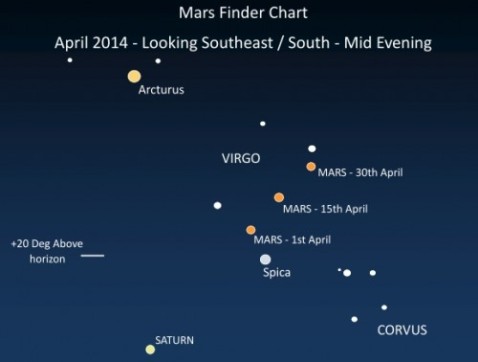
Image credit: Dark Sky Telescope Hire http://www.darkskytelescopehire.co.uk/see-mars-at-its-best-in-march-and-april-2014/
So in between mapping some fans and blotches tonight, take a break from classifying, look up, and catch a glimpse of the planet your clicks are helping us to better understand!
Planet Four Teacher Workshop Talk
As part of the workshop on Citizen Science in Astronomy that I helped co-organize at my research institute (the Institute of Astronomy & Astrophysics, Academia Sinica – ASIAA) earlier this month in Taipei, Taiwan, there was a teacher workshop. The teacher workshop was organized by Lauren Huang (ASIAA), Mei-Yin Chou (ASIAA), Stuart Lynn (Adler Planetarium/Zooniverse), Kelly Borden (Adler Planetarium/Zooniverse), and myself.
Teachers in Taiwan came to ASIAA on a Sunday to hear about citizen science and how they could use it in the classroom. I gave a talk to introduce the traditional character Chinese translation of Planet Four and talk about the science behind Planet Four. The talk (which is in English) is recorded so I thought I’d share:
Boulders in Inca City
Thanks to your help, we’ve been able to complete the set of Season 1 Manhattan images with 30 independent reviews. We’re now moving on to Inca City Season 1 images. You might notice bright light-colored small smooth circles and ovals in the images showing in the classification interface. Those features are actually boulders. HiRISE can resolve down to the size of a small coffee table on Mars, so those boulders aren’t so tiny!
It has been suggested from previous analysis that boulders may impact the prevalence of fans and blotches in Inca City. If you come across an image that has boulders, please discuss the image on Talk (hit the ‘Discuss’ button – it appears after you click the ‘Finish’ button once you’ve marked the fans and blotches in the images) and add the hashtag #boulders. This will mark the image as possibly having boulders, and the science team can look at these later to see if we can try and find any possible correlation with fan and blotch activity and morphology.
Below are some examples of images with boulders for reference. Click any of the images for a larger view and slide show:


Opportunity for a Summer Student to Work on Planet Four Data
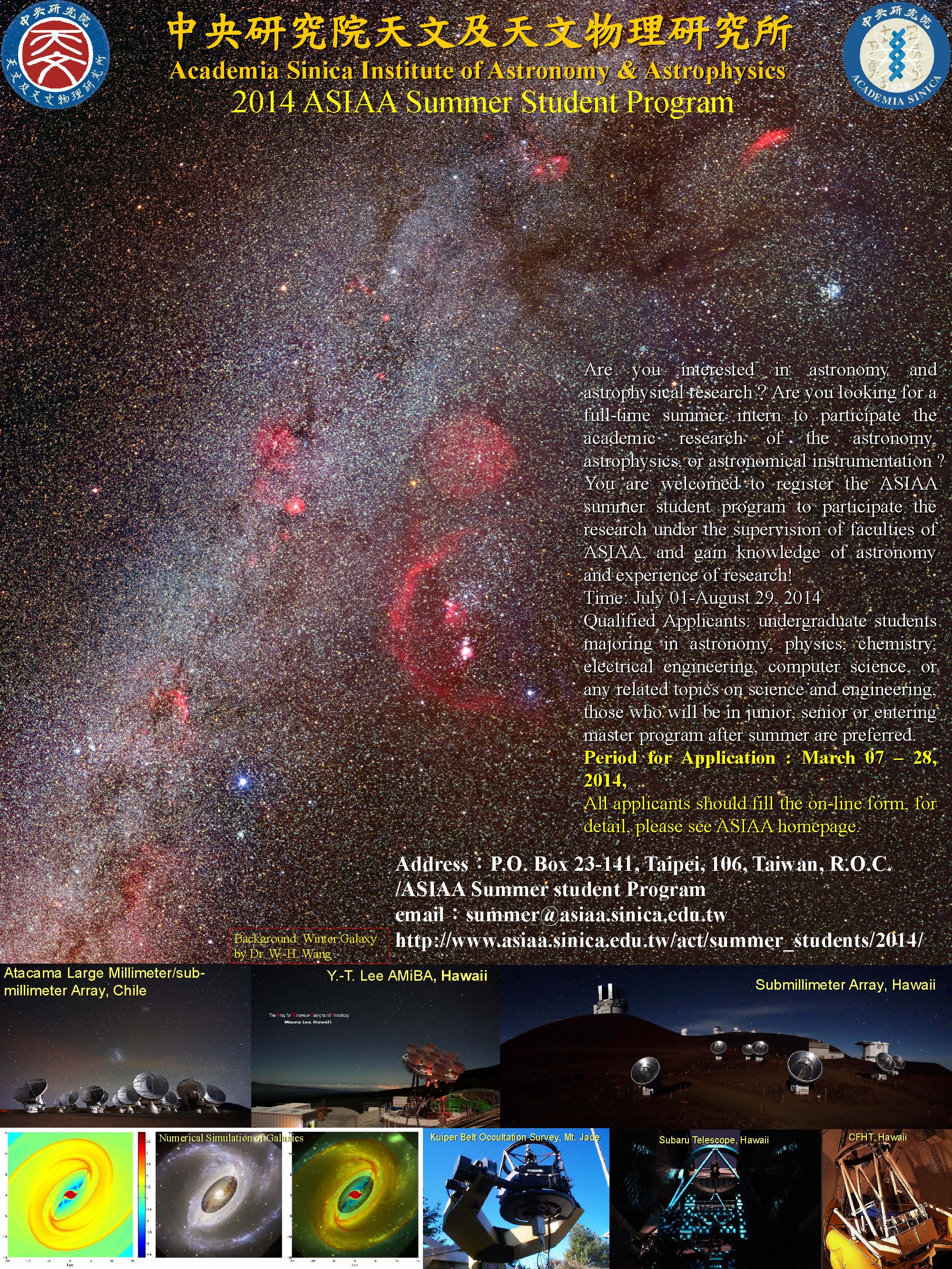
I’m a postdoctoral fellow at the Institute of Astronomy & Astrophysics at Academia Sinica (ASIAA) in a Taipei, Taiwan. As part of the 2014 ASIAA Summer Student Program, we’re looking for an undergraduate student to come to Taipei for the summer, from July 1st-August 29th, to work on Planet Four related research. ASIAA operates in English, and all research will be conducted in English. The description of the project can be found here. Details about the Summer Student Program including rules and restrictions can be found here.
Applications are due before March 28th. If you have questions or if you would like to know more, you can contact me via email at mschwamb AT asiaa.sinica.edu.tw
 Planet Four Blog
